
By Prabahan Kalita, co-founder of maarket.ai. Last reviewed: October 23, 2026. Every price, free tier and security claim was checked on the vendor's own pricing page, docs or trust page on this date. No platform on this list is a maarket.ai client, and this page carries no affiliate links.
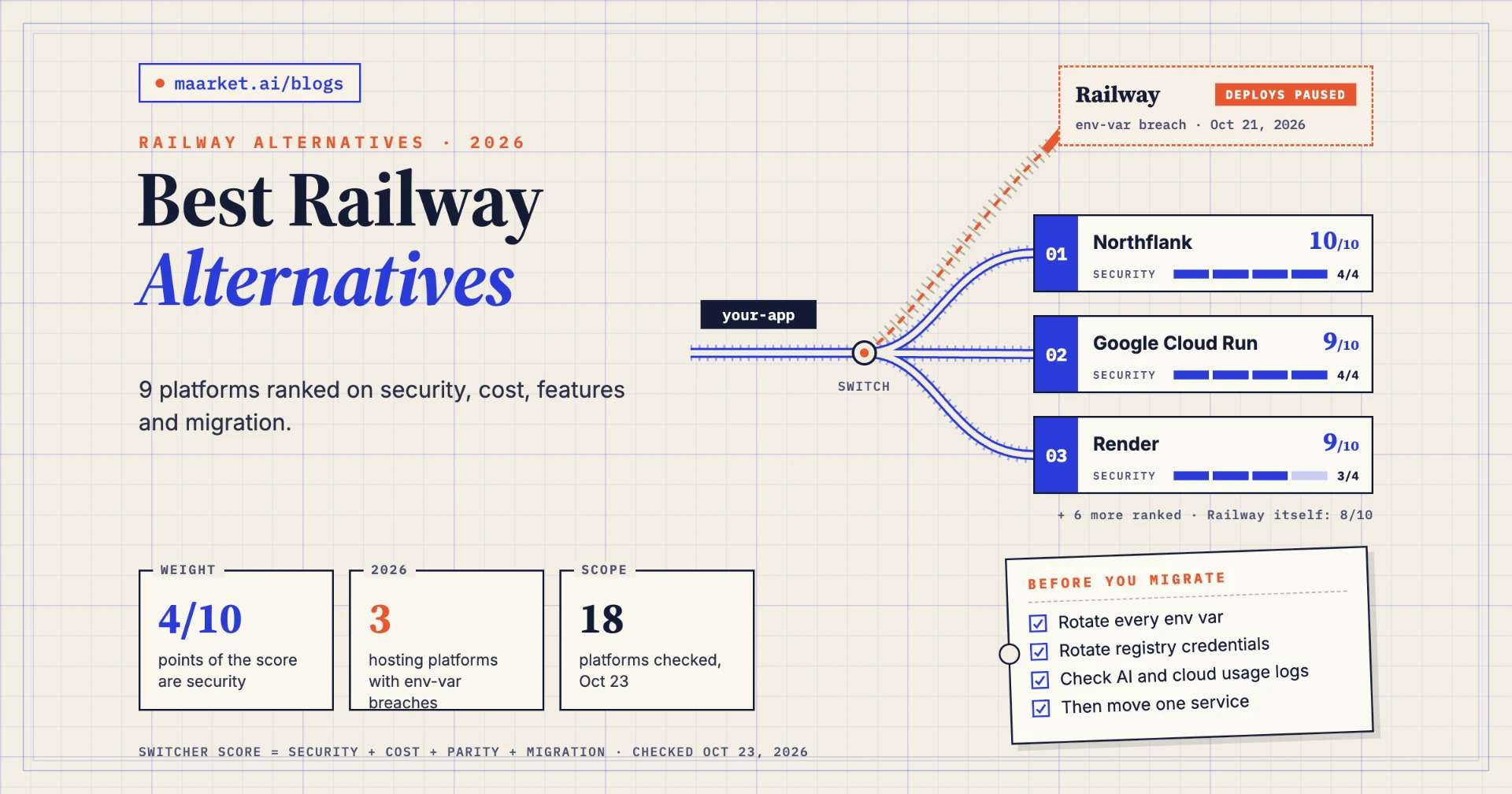
Railway alternatives are suddenly a live question. On October 21, 2026, Railway disclosed that an attacker may have accessed customer environment variables, and it paused deployments while it investigated. This list ranks the 9 best Railway alternatives for apps, APIs and workers on a published 10-point score. Security carries the most weight, followed by cost, Railway-style features and how easily a Railway app moves over.
Find developer tools and deployment platforms on Maarket →
Quick answer
The best Railway alternative in 2026 is Northflank (10/10): a free always-on sandbox, compute from $2.70 a month, managed Postgres, Redis and cron jobs, SOC 2 Type 2, and secrets that can stay in an external secret manager (a beta feature). Google Cloud Run (9/10) and Render (9/10) follow; Render is the closest like-for-like Railway replacement. Fly.io (8/10) is the strongest pick for secret handling, and Coolify, Dokploy and OpenShip are the cheapest, self-hosted way off Railway.
Two kinds of platform punch above their weight on security. Platforms that keep secrets out of reach of their own dashboard (Fly.io's write-only secrets vault, Cloud Run's Secret Manager, Northflank's external secret managers) score well because a platform-side breach exposes less. Self-hosted, open-source options keep secrets on servers you control, but you own the patching: Coolify and Dokploy both disclosed critical vulnerabilities in 2026.
Why this list matters
We built this list from scratch the week of Railway's disclosure, for teams deciding whether and where to move. It isn't a refresh of an old "Heroku alternatives" roundup.
- All 18 platforms we considered were checked on their own pricing pages, docs and trust pages on October 23, 2026.
- Every incident cited traces to the vendor's own disclosure, a CVE record or named press coverage.
- The platforms that missed the cut are listed with their scores and the reason.
- The scoring rubric is published in full, so you can re-weight it for your own team.
What is Railway?
Railway is a platform as a service (PaaS) that deploys apps, APIs, background workers, cron jobs and databases from a GitHub repo or Docker image, on a visual project canvas. It charges for the CPU, memory, storage and egress you use. Plans have a monthly minimum that includes the same amount in usage credits: Hobby $5 and Pro $20. New accounts get a 30-day trial with $5 in credits, then a free plan with $1 of usage credit a month (Railway pricing). A Railway alternative is any platform that can run the same long-running services and databases.
What happened at Railway, and what to do first
Railway disclosed on October 21, 2026 that it had detected anomalous activity in systems that store customer environment variables.
- What was exposed: an unauthorized third party may have accessed encrypted variables and, for some customers, their decrypted contents. Railway said the impact appeared limited to a subset of users and that it will email the accounts it confirms as affected.
- What Railway asked users to do: rotate every environment variable and private registry credential, and review service logs for unusual activity.
- Deployments: Railway paused all deployments during the investigation. By October 22, builds were restored for Pro and Enterprise workspaces, with Hobby, then Free and Trial, to follow.
- Real-world impact: The Hacker News reported, citing security researcher Taylor Monahan, that attackers drained cryptocurrency wallets whose private keys were stored on Railway.
- Attribution: Railway said it believes the attack was part of a wider campaign against platform companies aimed at reaching AI inference providers.
Railway was not the only hosting platform hit this year. Vercel disclosed in April 2026 that an attacker decrypted some customers' non-sensitive environment variables after compromising a third-party AI tool used by an employee (Vercel closed the incident on October 16). Zeabur disclosed two incidents, in late August and on October 14, 2026, when an attacker reached its internal systems and some customer services, and it announced it will shut down all services by December 31, 2026.
Rotate first, then migrate. Moving an app does not un-leak a key. Rotate every API key, database password and registry credential that ever lived in Railway. Check your cloud provider and AI provider logs for unusual use; Railway's disclosure post links to its October 22 guides on checking for anomalous GCP and AWS access. Only then migrate.
Railway alternatives at a glance
| Stat | Value |
|---|---|
| Platforms considered | 18 |
| Platforms scored on the full rubric | 13 (plus Railway as a baseline) |
| Platforms ranked in this list | 9 (every platform that matches or beats Railway's own score) |
| Railway's own switcher score | 8/10 (loses 2 points for the October 2026 incident) |
| Top score | 10/10 (Northflank) |
| Average score of the top 9 | 8.4/10 |
| Perfect 4/4 security score | 3 of 9 (Northflank, Google Cloud Run, Fly.io) |
| Free option for a backend service | 6 of 9 (Northflank, Cloud Run, Render, Coolify, Dokploy, OpenShip) |
| Open source and self-hostable | 3 of 9 (Coolify, Dokploy, OpenShip) |
| Hosting platforms with a disclosed security breach in 2026 | 3 (Railway, Vercel, Zeabur) |
The spread is tight: six platforms tie Railway at 8/10, and they get there differently. Managed platforms such as DigitalOcean App Platform and Sevalla carry SOC 2 audits but cost a few dollars more to start. Self-hosted tools such as Coolify and Dokploy are nearly free and run the same Nixpacks and Railpack builders Railway uses, but lose security points for critical vulnerabilities disclosed this year. Only three platforms beat Railway outright. That's by design: Railway's product is genuinely strong, and the rubric judges each platform on the same evidence rather than writing Railway off after one incident.
The 9 best Railway alternatives, ranked by switcher score
Railway switcher score (out of 10) = security (0–4) + cost (0–2) + Railway feature parity (0–2) + migration ease (0–2). Security = incident record over the last 12 months (0–2) + independent audit (0–1) + secrets isolation (0–1). The full rubric is in How we built this list. Prices in USD, checked October 23, 2026.
| Rank | Platform | Switcher score | Security (of 4) | Category | Free option | Paid entry point | Managed Postgres |
|---|---|---|---|---|---|---|---|
| 1 | Northflank | 10/10 | 4 | Managed PaaS with bring-your-own-cloud | Developer Sandbox: 2 services, 2 jobs, 1 database, always on | $2.70/month (0.1 vCPU, 256 MB) | Yes, plus MySQL, MongoDB and Redis |
| 2 | Google Cloud Run | 9/10 | 4 | Serverless containers on Google Cloud | Monthly free tier (180,000 vCPU-seconds, 2M requests) | Pay per use, no plan fee | No, added separately |
| 3 | Render | 9/10 | 3 | Railway-style managed PaaS | Free web service (sleeps after 15 min idle); free Postgres expires after 30 days | $7/month web service; Postgres from $6/month | Yes, plus Key Value |
| 4 | Fly.io | 8/10 | 4 | Global micro-VM platform | Trial only (2 machine-hours or 7 days) | $2.19/month machine; Managed Postgres from $38/month | Yes |
| 5 | OpenShip | 8/10 | 3 | Open-source PaaS, cloud or self-hosted | Free to self-host | Openship Cloud from $5/month | Yes |
| 6 | DigitalOcean App Platform | 8/10 | 3 | Managed PaaS on DigitalOcean | 3 static sites only | $5/month container; dev Postgres $7/month | Yes |
| 7 | Sevalla | 8/10 | 3 | Managed PaaS by Kinsta | Free trial; free static sites | $5/month apps; databases from $5/month | Yes, plus MySQL, MariaDB, Redis, Valkey |
| 8 | Coolify | 8/10 | 2 | Open-source self-hosted PaaS | Free to self-host | Coolify Cloud $5/month (2 servers) | Yes, self-managed |
| 9 | Dokploy | 8/10 | 2 | Open-source self-hosted PaaS | Free to self-host | Dokploy Cloud $4.50/month per server | Yes, self-managed |
Ties are broken by security score, then cost score, then alphabetically. Self-hosted prices exclude the server you run them on.
1. Northflank: best overall Railway alternative
Score: 10/10 · Managed PaaS with bring-your-own-cloud
Is Northflank free? Yes. Northflank's Developer Sandbox runs 2 services, 2 jobs and 1 database, always on with no sleeping, and covers up to $20 a month of resources. Paid compute starts at $2.70 a month (0.1 vCPU, 256 MB).
Northflank runs services, cron jobs and databases (Postgres, MySQL, MongoDB, Redis) from Dockerfiles or buildpacks. It can also run inside your own AWS, GCP or Azure account (BYOC).
- Security strength: SOC 2 Type 2, Kata Containers isolation, and secrets that can live in an external secret manager (currently in beta) instead of Northflank's database.
- Watch out: SAML SSO and audit logging sit on the Enterprise plan.
- Best for: startups that expect to outgrow a starter PaaS.
2. Google Cloud Run: best for security controls at low traffic
Score: 9/10 · Serverless containers on Google Cloud
Is Google Cloud Run free? Partly. A monthly free tier covers 180,000 vCPU-seconds and 2 million requests; beyond that, Cloud Run bills per use with no plan fee.
Cloud Run deploys any container, or builds your source with your Dockerfile or Google's buildpacks, and scales to zero when idle.
- Security strength: in scope for Google Cloud's SOC 2 reports, with secrets mounted from Secret Manager rather than stored as plain variables.
- Watch out: no built-in database or Railway-style canvas; you assemble Postgres, networking and IAM yourself.
- Best for: teams comfortable in Google Cloud who want the strongest security controls at low traffic.
3. Render: closest like-for-like Railway replacement
Score: 9/10 · Railway-style managed PaaS
Is Render free? Yes, with limits. Free web services sleep after 15 idle minutes, and free Postgres expires after 30 days. Always-on web services start at $7 a month and Postgres at $6 a month (Render pricing).
Render puts web services, background workers, cron jobs, Postgres and Key Value in one dashboard, built from a Dockerfile or native runtimes. It's the platform whose workflow feels most like Railway's.
- Security strength: ISO 27001, SOC 2 Type 2 and HIPAA support, with no publicly disclosed breach in the last 12 months.
- Watch out: no write-only secret option documented, and audit logs need the $25-a-month Pro workspace.
- Best for: teams that want Railway's workflow without self-managing anything.
4. Fly.io: best for secret handling and global latency
Score: 8/10 · Global micro-VM platform
Is Fly.io free? No. New accounts get a trial (2 machine-hours or 7 days), and a card is required. The smallest Fly.io machine costs $2.19 a month, and Managed Postgres starts at $38 a month.
Fly.io runs apps as Firecracker micro-VMs close to users. fly launch detects your framework, writes a fly.toml and can provision Postgres and Redis.
- Security strength: secrets go into an encrypted vault that Fly's API can encrypt but not decrypt, and values can never be read back; SOC 2 Type 2.
- Watch out: no free tier for new accounts, and Git deploys run through GitHub Actions.
- Best for: latency-sensitive apps and teams happy with a CLI.
5. OpenShip: best cloud-to-self-host exit path
Score: 8/10 · Open-source PaaS, cloud or self-hosted
Is OpenShip free? Yes, to self-host. OpenShip is Apache 2.0 licensed; Openship Cloud starts at $5 a month, and a hybrid mode runs both.
OpenShip deploys from git push across major languages, Docker and Compose, with Postgres, MySQL, MongoDB and Redis.
- Security strength: passkeys and 2FA, scoped access tokens, audit history and encrypted saved credentials.
- Watch out: no SOC 2 or ISO 27001 published, and its API container mounts the host Docker socket, so OpenShip advises running it only on a trusted host.
- Best for: teams that want to start in the cloud and keep the option to self-host.
6. DigitalOcean App Platform: best for existing DigitalOcean users
Score: 8/10 · Managed PaaS on DigitalOcean
How much does DigitalOcean App Platform cost? Containers start at $5 a month and a development Postgres database at $7. Only static sites are free (up to 3).
DigitalOcean App Platform runs services, workers and cron jobs, preferring your Dockerfile and falling back to buildpacks.
- Security strength: SOC 2 and SOC 3 reports, with no publicly disclosed breach in the last 12 months.
- Watch out: "Encrypt" hides variables from logs, but team members with console access can still read them.
- Best for: teams already using DigitalOcean Droplets or Managed Databases.
7. Sevalla: best for agencies and predictable support
Score: 8/10 · Managed PaaS by Kinsta
How much does Sevalla cost? Apps and databases each start at $5 a month, across 25 data centers. There's a free trial and free static sites, but no permanent free tier for apps.
Sevalla is Kinsta's application platform: web processes, background workers and cron jobs built with Nixpacks, Railpack, buildpacks or a Dockerfile, plus managed Postgres, MySQL, MariaDB, Redis and Valkey.
- Security strength: covered by Kinsta's SOC 2 Type II audit and ISO 27001:2022 certification.
- Watch out: no write-only secrets documented.
- Best for: agencies and teams wanting predictable support.
8. Coolify: best free self-hosted Railway alternative
Score: 8/10 · Open-source self-hosted PaaS
Is Coolify free? Yes, to self-host; you pay only for your server. Coolify Cloud, which manages it for you, costs $5 a month for two servers.
Coolify uses the same Nixpacks and Railpack builders as Railway, plus Dockerfile and Docker Compose. One-click databases come with scheduled backups to S3, and apps can run cron-style scheduled tasks.
- Security strength: secrets and data stay on your own servers.
- Watch out: several critical and high-severity advisories in mid-2026, including CVE-2026-34038 (CVSS 9.9, fixed in 4.0.0-beta.469). Patch promptly and restrict team permissions.
- Best for: indie hackers moving several small apps.
9. Dokploy: best for cost-focused teams with a VPS
Score: 8/10 · Open-source self-hosted PaaS
Is Dokploy free? Yes, to self-host. Dokploy Cloud manages your servers for $4.50 a month each.
Dokploy builds with Nixpacks (default), Railpack, Dockerfiles or Heroku and Paketo buildpacks, and manages Postgres, MySQL, MongoDB, MariaDB and Redis.
- Security strength: secrets stay on servers you control, never in a shared multi-tenant store.
- Watch out: critical (CVSS 9.9) vulnerabilities were disclosed in January and May 2026; patch promptly.
- Best for: cost-focused teams with a VPS.
Railway vs Render: which should you choose?
Render is the closest alternative to Railway, so it's the comparison most teams make first.
| Railway | Render | |
|---|---|---|
| Pricing model | Usage-based: Hobby $5 and Pro $20 monthly minimums, each including the same amount in usage credits | Fixed instances: web services from $7/month, Postgres from $6/month; Pro workspace $25/month plus compute |
| Free option | 30-day trial with $5 credits, then a free plan with $1 of usage credit a month | Free web service (sleeps after 15 idle minutes); free Postgres for 30 days |
| Services | Web, workers, cron, databases on a visual canvas | Web, workers, cron, Postgres and Key Value in one dashboard |
| Builds | GitHub repo or Docker image (Railpack/Nixpacks) | Dockerfile or native runtimes |
| Security, last 12 months | Customer environment variables accessed, October 2026 | No publicly disclosed breach found; ISO 27001, SOC 2 Type 2 |
| Switcher score | 8/10 (baseline) | 9/10 |
Verdict: choose Render if you want Railway's workflow with predictable per-instance pricing and a clean recent security record. Railway can still be cheaper for small, bursty workloads because you pay only for what you use.
Railway alternatives that missed the top 9
We scored 4 more platforms that often appear in Railway alternative roundups and cut 5 others. Each scored platform is a credible product; they scored below Railway's 8/10 on this rubric.
| Platform | Switcher score | Why it missed the top 9 |
|---|---|---|
| Porter | 7/10 | Strong security (SOC 2 Type II, runs in your own cloud), but no free tier, its fee excludes your AWS, GCP or Azure bill, and builds run through a GitHub Actions workflow |
| Heroku | 7/10 | No free tier (Eco $5/month sleeps after 30 minutes), Docker builds need a heroku.yml, and Heroku moved to a sustaining engineering model in February 2026, focused on stability and security rather than new features |
| Koyeb | 7/10 | One free web service, but paid plans start at $29/month (Pro), and its forum points to workarounds rather than native cron jobs; acquired by Mistral AI in February 2026 |
| Vercel | 3/10 | Built for frontends and functions rather than long-running containers, and disclosed an April 2026 incident in which non-sensitive environment variables were decrypted |
| Zeabur | Cut | Two breaches in 2026; shutting down all services by December 31, 2026 |
| AWS App Runner | Cut | Closed to new customers; AWS recommends Amazon ECS Express Mode instead |
| Upsun | Cut | €19 a month in project and user fees before resources, and managed Postgres and Redis pricing not listed on its pricing page |
| Clever Cloud | Cut | Entry price only available through a calculator we could not verify |
| Qovery | Cut | Starts at $299 a month billed yearly; a platform-team product rather than a Railway swap |
Porter is the one to look at if your company already runs on AWS and wants Railway-style deploys inside its own account: it missed the cut on cost, not on security.
Security strengths and weaknesses, side by side
| Platform | Incident record, last 12 months | Independent audit | How secrets are protected | Biggest security gap |
|---|---|---|---|---|
| Railway (baseline) | Customer environment variables accessed, October 2026 | SOC 2 Type II, SOC 3 | Sealed variables are hidden from the UI and API | The incident itself; scope still being confirmed |
| Northflank | None found | SOC 2 Type 2, HIPAA | External secret managers (beta); BYOC | SSO and audit logging are Enterprise-only |
| Google Cloud Run | None found | Google Cloud SOC 2 (Cloud Run in scope) | Secret Manager mounts | IAM complexity: misconfiguration is on you |
| Render | None found | ISO 27001, SOC 2 Type 2 | Environment groups and secret files | No documented write-only secrets |
| Fly.io | None found | SOC 2 Type 2 | Write-only encrypted vault | Card required; no free tier to test on |
| OpenShip | None found | None published | Encrypted saved credentials; self-host option | Host-privileged Docker socket; no published audit |
| DigitalOcean App Platform | None found | SOC 2, SOC 3 | "Encrypt" hides values from logs | Console users can read encrypted values |
| Sevalla | None found | SOC 2 Type II, ISO 27001:2022 | Not documented | No write-only secrets documented |
| Coolify | Critical advisories disclosed (Jun and Jul 2026) | None (self-hosted) | On your own servers | You patch and harden the host |
| Dokploy | Critical CVEs disclosed (Jan and May 2026) | None (self-hosted) | On your own servers | You patch and harden the host |
"None found" means we found no vendor disclosure, CVE record or credible press report of a breach or critical vulnerability between October 23, 2025 and October 23, 2026. It is not a guarantee.
Which type of Railway alternative should you choose?
| If you want… | Choose |
|---|---|
| The closest Railway-style dashboard | Render, Sevalla, DigitalOcean App Platform |
| The strongest secret handling | Fly.io, Google Cloud Run, Northflank |
| To run in your own cloud account | Northflank (BYOC), Porter |
| A free, open-source, self-hosted option | Coolify, Dokploy, OpenShip |
| The same builders as Railway (Nixpacks, Railpack) | Coolify, Dokploy, Sevalla |
| Serverless that scales to zero | Google Cloud Run |
| Low latency worldwide | Fly.io |
| Compliance support (HIPAA, ISO 27001) | Render, Northflank, Sevalla, Google Cloud Run |
| A Heroku-style option as well | Render or Northflank; Heroku itself scored 7/10 |
Why security should carry the most weight when you switch
A hosting platform holds the keys to everything your app touches: database passwords, payment and email API keys, cloud credentials and, increasingly, AI provider keys that attackers can spend directly. That's why the switcher score gives security 4 of its 10 points, and why the incident record counts for half of that.
A platform that keeps secrets write-only, or outside its own systems entirely, limits what a platform-side breach can expose. Vercel's April incident shows why: the attacker decrypted variables that were not marked sensitive, and Vercel's advice afterward was to use sensitive variables, whose values cannot be read back.
Should you leave Railway, or stay?
Rotate your Railway secrets today, whatever you decide. If Railway's final findings and response hold up, staying with sealed variables and tighter scopes can be a reasonable choice. If you move, migrate one non-critical service first (see the steps below). If you're deploying apps built with AI app builders, our Lovable vs Emergent comparison covers where those tools fit.
How to migrate from Railway without downtime
- Rotate secrets. Rotate every key, password and registry credential that lived in Railway, and check provider logs for unusual use. List your variable names with Railway's CLI (
railway variables) so you can recreate them on the new platform with the new values. - Deploy the same repo. Point your chosen platform at the repo and build from your Dockerfile, or with Nixpacks or Railpack on Coolify, Dokploy or Sevalla.
- Move data. Dump your Railway Postgres with
pg_dumpand restore it withpg_restoreon the new platform. Copy any files stored on Railway volumes, and replace private-network hostnames (*.railway.internal) with the new platform's internal addresses. - Test on a staging domain. Point a staging subdomain at the new app and run real requests against it.
- Lower DNS TTLs, then switch. Cut the production domain over once the TTL has expired.
- Run in parallel for a week. Keep Railway running until the new setup has handled a full week of real traffic, then shut it down.
How we built this list
Sourcing. We started with a broad search across Railway alternative roundups, Reddit and community threads, vendor comparison pages and security news from October 2026, then shortlisted 18 platforms that can host a long-running web service. Every price, free tier, database option, build method and security claim was checked on the vendor's own pricing page, docs or trust page on October 23, 2026. JavaScript-rendered pricing pages were read in a live browser. Incidents were searched per platform across vendor disclosures, CVE records and security press for October 23, 2025 to October 23, 2026.
Scoring. Each platform was scored on four areas.
| Area | Points | How it's scored |
|---|---|---|
| Security: incident record | 0–2 | 2 = none found; 1 = critical (CVSS 9.0+) vulnerability disclosed in the product with no platform breach reported; 0 = disclosed breach exposing customer secrets or data |
| Security: independent audit | 0–1 | 1 = SOC 2 Type II or ISO 27001 covering the hosted platform |
| Security: secrets isolation | 0–1 | 1 = write-only secrets, an external secret manager, or secrets kept on infrastructure you control |
| Cost | 0–2 | 1 point for a free option that can run a backend service (sleeping allowed, self-hosting counted); 1 point for a paid entry point of $10 a month or less with no separate cloud account required |
| Railway parity | 0–2 | 2 = managed Postgres, Redis or key-value, background workers and cron jobs on one platform; 1 = one of these missing or sold separately; 0 = no long-running services |
| Migration ease | 0–2 | 2 = connect a Git repo and it builds a Dockerfile or detects the language with no platform config file; 1 = needs a platform config file, CLI step or CI workflow; 0 = needs a rewrite for serverless functions |
Ranking. Railway itself was scored on the same rubric as a baseline and is not ranked. Only platforms scoring at or above Railway's 8/10 are ranked. Ties were broken by security score, then cost score, then alphabetically. Self-hosted prices exclude the server. No platform on this list is a maarket.ai client.
Key terms
- PaaS (platform as a service): a hosting platform that builds and runs your app from code, so you don't manage servers. Railway, Render and Northflank are PaaS.
- Environment variables: settings stored outside your code, often secrets such as API keys and database passwords. They are what Railway's incident may have exposed.
- Write-only secrets: secrets the platform can use but that no one, including the platform's own dashboard or API, can read back.
- External secret manager: a separate service (such as AWS Secrets Manager or HashiCorp Vault) that holds secrets so the hosting platform doesn't store them.
- BYOC (bring your own cloud): the platform deploys into your own AWS, GCP or Azure account instead of its shared infrastructure.
- Nixpacks and Railpack: open-source builders that detect your language and build a container without a Dockerfile. Railway created both.
- SOC 2 Type II: an independent audit of a company's security controls over a period of time.
- CVSS: a 0–10 severity score for vulnerabilities; 9.0 and above is "critical".
- Scale to zero: the app shuts down when idle and starts on the next request, so you pay nothing while it's idle.
Frequently asked questions
What is the best Railway alternative?
Northflank is the best Railway alternative in maarket.ai's October 2026 ranking, scoring 10/10 on the Railway switcher score. It offers a free always-on Developer Sandbox, compute from $2.70 a month, managed Postgres, Redis and cron jobs, a SOC 2 Type 2 audit, and support for external secret managers. Google Cloud Run and Render follow at 9/10.
What happened in the Railway security incident?
On October 21, 2026, Railway disclosed anomalous activity in systems that store customer environment variables. An unauthorized party may have accessed encrypted variables and, for some customers, their decrypted values. Railway paused deployments, asked all users to rotate every variable and registry credential, and began restoring builds on October 22.
Is Railway still safe to use?
Railway is still operating and holds SOC 2 Type II and SOC 3 reports, but its October 2026 disclosure means every secret stored there should be treated as exposed until rotated. Whether to stay depends on Railway's final findings. Rotate credentials first, use sealed variables for anything sensitive, and review logs for unusual activity either way.
What is the closest alternative to Railway?
Render is the closest like-for-like Railway alternative. It puts web services, background workers, cron jobs, Postgres and Key Value in one dashboard, builds from a Dockerfile or native runtimes, and offers a free web service tier. Sevalla and DigitalOcean App Platform offer a similar dashboard experience from $5 a month.
Railway vs Render: which is better?
Render scores higher (9/10 vs Railway's 8/10) because it has no disclosed breach in the last 12 months and offers fixed per-instance pricing from $7 a month. Railway's usage-based pricing (Hobby $5 minimum, Pro $20 minimum, both including usage credits) can be cheaper for small or bursty workloads.
Is there a free Railway alternative?
Yes. Northflank's Developer Sandbox runs 2 services, 2 jobs and 1 database for free with no sleeping. Render offers free web services that sleep after 15 idle minutes. Google Cloud Run has a monthly free tier. Coolify, Dokploy and OpenShip are free to self-host, though you pay for the server.
Is Railway free?
Not permanently for real workloads. Railway gives new accounts a 30-day trial with $5 in credits, then a free plan with $1 of usage credit a month, limited to 1 vCPU and 0.5 GB RAM per service. Paid plans have a $5 (Hobby) or $20 (Pro) monthly minimum that includes the same amount of usage.
Which Railway alternative is the most secure?
Northflank, Google Cloud Run and Fly.io score a perfect 4 out of 4 on maarket.ai's security rubric: no breach or critical vulnerability found in the past 12 months, an independent SOC 2 audit, and secrets kept outside readable platform storage. Fly.io's secrets vault, for example, lets Fly's API encrypt secrets but never decrypt them.
What is the best open-source Railway alternative?
Coolify, Dokploy and OpenShip are the open-source Railway alternatives on this list, all scoring 8/10. Coolify and Dokploy use the same Nixpacks and Railpack builders as Railway. OpenShip (Apache 2.0) also offers a managed cloud from $5 a month. All three put patching on you.
Should I self-host instead of using Railway?
Self-hosting with Coolify, Dokploy or OpenShip is the cheapest way to leave Railway and keeps secrets on servers you control. The trade-off is patching: Coolify and Dokploy both disclosed critical vulnerabilities in 2026. Self-host if someone on your team will update the platform promptly and harden the server; otherwise choose a managed platform.
How do I migrate from Railway without downtime?
Rotate every Railway secret first, then deploy the same repo to the new platform using its Dockerfile or Nixpacks build. Dump and restore your Postgres database, point a staging domain at the new app, test, then lower DNS TTLs and switch the production domain. Keep Railway running until the new platform has handled a week of traffic.
Update log: first published October 23, 2026. Railway's investigation is ongoing; we'll update this page when Railway publishes final findings, and re-check all prices in January 2027.
Moving your app after the Railway incident?
Roundups and launch-week buzz tell you which platform was popular once, not which one teams still trust six months after an incident. Maarket ranks software on continuous signals from real users (reviews, recommendations and "I use this" flags, tracked as Karma Points), so the platforms teams keep trusting keep rising. Use this list for the security and switching math, then check what teams like yours actually run in production.
Browse developer tools on Maarket →
Building a deployment platform yourself? List your product on Maarket →
Related reading: Lovable vs Emergent: Which AI App Builder Should You Pick in 2026? · Best MCP Servers in 2026: Which Business Apps Have an Official MCP Server?