
Last verified: 20 October 2026. Every price below was read from the vendor's official pricing page or documentation on this date. Prices are in USD per month on monthly billing unless noted, before tax.
By Kabandi Saikia, co-founder and Chief M-aa-rket-er at maarket.ai, a distribution platform for products. The order is editorial and value-led (see How we picked), not taken from maarket.ai's community rankings. No vendor paid for inclusion or placement, and this page carries no affiliate links.
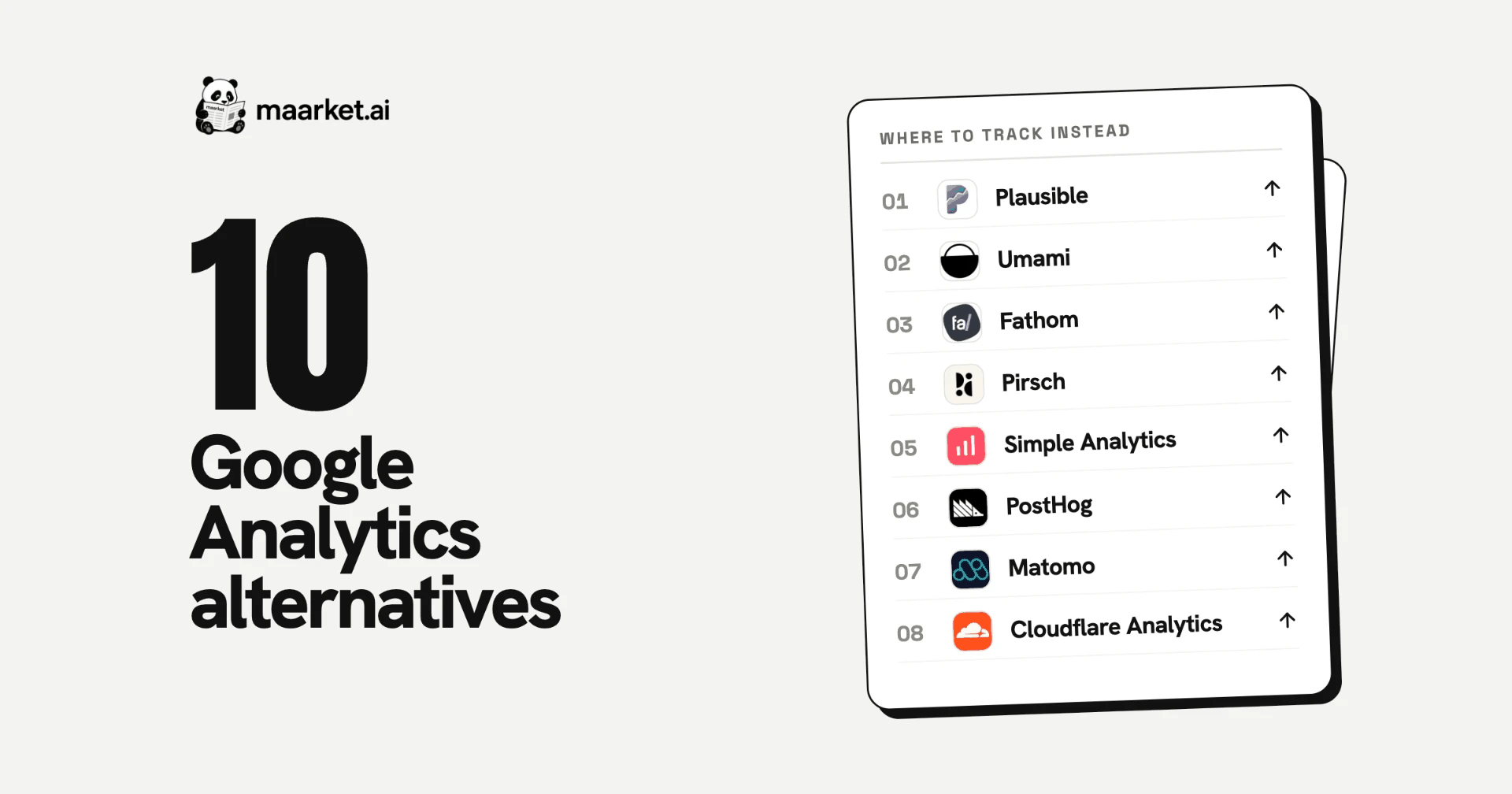
Quick answer: The best Google Analytics alternatives in 2026 are Plausible ($19/month at 100k pageviews), Umami (free for 100k events, or free to self-host), Fathom ($15/month for 100k pageviews across 50 sites), Pirsch ($12/month at 100k) and PostHog (1M free events a month for SaaS). For indie hackers, DataFast and Seline tie traffic to Stripe revenue. Standard GA4 stays free but keeps detailed data for 14 months at most.
Top picks by use case
- Best overall Google Analytics alternative: Plausible, simple, cookieless and EU-hosted
- Best free Google Analytics alternative: Umami, 100k events free on its cloud, unlimited when self-hosted
- Best for agencies and many sites: Fathom, 50 sites on the $15 plan
- Cheapest paid plan at 100k pageviews: Pirsch at $12/month or $120/year
- Best for SaaS product analytics: PostHog
- Closest to Google Analytics' depth, with data ownership: Matomo
- Best for indie hackers who want revenue attribution: DataFast and Seline
Comparison at a glance
Prices are for about 100,000 monthly pageviews, a common traffic level for early-stage sites.
| # | Tool | Free option | Price at ~100k pageviews (monthly billing) | Yearly cost at ~100k* | Cookieless by default | Open source | Best for |
|---|---|---|---|---|---|---|---|
| — | Google Analytics 4 (baseline) | Free | $0 | $0 | No | No | Ads-heavy teams that need Google integration |
| 1 | Plausible | 30-day trial; free self-host (Community Edition) | $19 (Starter, 1 site) | $190 | Yes | Yes (AGPLv3) | Simple, privacy-first GA replacement |
| 2 | Umami | Free cloud plan (100k events, 1 site); free self-host | $0 (Hobby) · $20 Pro for 1M events | $0 | Yes | Yes (MIT) | Free and open source |
| 3 | Fathom | 7-day trial (card required) | $15 (50 sites) | ~$150 | Yes | No | Agencies and many sites |
| 4 | Pirsch | 30-day trial | $12 (Standard, 50 sites) | $120 | Yes | Core library (AGPLv3) | Cheapest paid EU-hosted plan |
| 5 | Simple Analytics | Free plan (5 sites, 1 month history, badge) | $20 | ~$200 | Yes | No | Small sites starting free |
| 6 | PostHog | 1M events/month free | $0 | $0 | Optional mode | Yes (MIT) | SaaS product + web analytics |
| 7 | Matomo | Free self-host (On-Premise) | $42 (Cloud, 100k hits) | ~$420 | Configurable | Yes (GPLv3) | GA-level depth, data ownership |
| 8 | Cloudflare Web Analytics | Free | $0 | $0 | Yes | No | Free basics, zero setup |
| 9 | Mixpanel | 1M events/month free | $0 | $0 | Not stated by vendor | No | Funnels and retention |
| 10 | Microsoft Clarity | Free | $0 | $0 | No (uses cookies) | No | Heatmaps and session recordings alongside another tool |
\Yearly cost uses each vendor's annual price where it is printed (Plausible and Pirsch above; Seline, Rybbit and OpenPanel in the indie table). Fathom, Simple Analytics and Matomo advertise "2 months free" on yearly billing without printing the figure, so their yearly cost is our calculation (10 × the monthly price), marked "~". Umami, PostHog and Mixpanel count events rather than pageviews; 100k pageviews fits inside their free allowances, but custom events also count toward the limit. Plausible, Fathom and Pirsch also count custom events against the pageview allowance. Umami's Hobby plan is capped at exactly 100k events with no add-ons, so a ~100k-pageview site with any custom events needs Pro ($20). Matomo counts "hits", which include more than pageviews.*
Cheapest at 100k pageviews, yearly: Umami, PostHog, Cloudflare, Mixpanel, Clarity, GoatCounter and GA4 $0 · Pirsch $120 · Fathom ~$150 · Rybbit $156 · Plausible $190 · DataFast ~$190 · Simple Analytics ~$200 · OpenPanel $200 · Seline $240 · Matomo Cloud ~$420.
How we picked: a tool made the main list only if it can replace Google Analytics' core job (traffic, sources, pages, conversions) or is the most common companion to it, and if its pricing is published on its own website. We compared every tool at the same traffic level, 100k monthly pageviews, because entry prices for 10k pageviews hide the real cost. Prices were read from official pricing pages on 20 October 2026, including the pageview sliders on Plausible's, Pirsch's, DataFast's and Rybbit's pages. Features are summarised from each vendor's own pricing pages and documentation; we did not run a side-by-side traffic-accuracy test. The order is editorial: it weighs price at 100k pageviews, the free option, features included at that price, and how closely the tool matches what a small team uses Google Analytics for.
Why teams look for GA4 alternatives in 2026
- GA4 is free in money but not in time. The core questions most small sites ask of Google Analytics are five: how many visitors, from where, to which pages, on which devices, and did they convert. GA4 answers them through a reporting model built on events and explorations, which is why simpler alternatives such as Plausible, Fathom and Umami put those answers on one dashboard.
- Your detailed data expires. Standard GA4 properties keep user-level and event-level data for 2 or 14 months (paid GA4 360 offers longer retention). That limits explorations and funnel reports (standard aggregated reports aren't affected). Plausible's Starter plan keeps 3 years, Umami Pro 2 years, and Pirsch advertises unlimited data retention.
- GA4 hides small numbers. Google applies data thresholds that withhold rows when user counts are low, and you can't switch them off. On a small site, that can hide exactly the early signals you're looking for.
- The consent banner is part of the real cost. Google expects sites to collect consent before setting Analytics cookies in regions that require it, through Consent Mode. Cookieless tools such as Plausible, Fathom, Simple Analytics and Umami say their default setup needs no cookie banner. A banner costs you data, because visitors who decline aren't counted in the same way. (Vendor claims aren't legal advice; Matomo itself notes that consent may still be required in some countries even when cookies are off.)
- Paid alternatives are cheap at small scale, then grow with traffic. At 100k monthly pageviews, the paid hosted tools here cost $12 to $42 a month. At 1M, Plausible Starter is $69 a month. If you expect fast traffic growth, compare the 1M tier before you commit, or choose a free self-hosted option (Plausible Community Edition, Umami, Matomo, Rybbit).
- Universal Analytics is gone; GA4 is not. Google stopped processing data in standard Universal Analytics properties on 1 July 2023. Google Analytics itself isn't discontinued: GA4 is the current, free version.
1. Plausible: best overall Google Analytics alternative
How much does Plausible cost? Starter is $9 a month for 10k pageviews, $19 for 100k ($190 a year, 2 months free), $29 for 200k and $69 for 1M. Plausible is a lightweight, cookieless analytics tool hosted in the EU (Germany). Every plan includes goals and custom events, email and Slack reports, saved segments and Google Analytics import. Growth ($29 at 100k) adds up to 3 sites and 3 team members, shared links and embedded dashboards. Business ($39 at 100k) adds funnels, ecommerce revenue attribution, custom properties, the Stats API and 5 years of retention. Plausible also tracks scroll depth automatically, shows traffic from AI tools such as ChatGPT and Perplexity, and connects to Search Console.
Free option: a 30-day trial with no card, or the free, self-hosted Community Edition (AGPLv3), which skips funnels, revenue goals and some integrations.
Budget watch-out: Starter covers one site with no team members. Two sites or a teammate means Growth.
Why it ranks above cheaper Pirsch: Plausible adds Search Console data, AI-referrer reports, automatic scroll-depth tracking and a free self-hosted edition, which covers more of what a GA4 user is giving up. If price, site count or seats matter most, pick Pirsch.
Best for: founders and marketers who want Google Analytics' core answers on one page, without cookies.
2. Umami: best free Google Analytics alternative
Is Umami free? Yes. The cloud Hobby plan is $0 for 100k events a month, 1 website and 6 months of retention, and self-hosting is free under the MIT license. Umami is cookieless and collects no personal data, and its pricing page states no cookie banner is required on any tier. Pro is $20 a month for 1M events, up to 20 websites and 10 team members, with 2 years of retention and API and MCP access. Business, at $200 a month for 10M events, adds session replays and heatmaps.
Budget watch-out: events include custom events, not just pageviews, and Hobby can't buy extra events. One busy site with event tracking can outgrow it quickly.
Best for: anyone who wants a free, open-source analytics dashboard, hosted or on their own server.
3. Fathom: best for agencies and many sites
How much does Fathom cost? $15 a month for up to 100,000 pageviews, with 50 sites included; $25 for 200k and $45 for 500k. Fathom has one feature set on every plan: event and revenue tracking, UTM tracking, shared dashboards, bot filtering, the Analytics API, unlimited email reports and a GA4 importer. It doesn't use cookies, and EU visitor data is processed in the EU.
Free option: none. A 7-day trial needs a card.
Budget watch-out: pageviews and custom events share the allowance. Extra packs of 50 sites cost $10 a month.
Best for: freelancers and agencies running analytics for many client sites on one bill.
4. Pirsch: cheapest paid plan at 100k pageviews
How much does Pirsch cost? Standard is $6 a month for 10k pageviews and $12 a month for 100k ($120 a year). Pirsch is made and hosted in Germany and is cookie-free. Standard includes 50 websites, unlimited team members, unlimited data retention, events and conversion goals, a REST API and SDKs, Google Analytics import and a built-in URL shortener. Plus ($27 at 100k, $270 a year) adds unlimited websites, funnels, A/B segmentation and white-labelling.
Free option: a 30-day trial with no card, capped at 100,000 pageviews.
Budget watch-out: custom events count toward the pageview limit, and prices exclude VAT.
Best for: small teams and agencies that want EU hosting and unlimited seats at the lowest paid price.
5. Simple Analytics: best free plan for several small sites
Is Simple Analytics free? Yes: 1 user, 5 websites and 1 month of history, with a required badge on your site. Simple Analytics keeps data in the Netherlands, uses no cookies and collects no personal data. The paid self-serve plan starts at $20 a month for 100k pageviews, with extra users at $20 a month each. Features include automated event tracking, goals and funnels, an AI assistant, GA4 import and email reports.
Budget watch-out: each extra user adds $20 a month, which doubles the price for a two-person team.
Best for: side projects and small sites that want to start free and stay cookieless.
6. PostHog: best for SaaS teams that need product analytics too
Is PostHog free? Yes: 1M events a month, shared between web and product analytics, plus 5,000 session recordings, with no card. PostHog (see it on maarket.ai) gives you a web analytics dashboard (visitors, sources, UTMs, Core Web Vitals) and, from the same events, product analytics, session replay, feature flags and experiments. Above 1M events, web and product analytics cost $0.00005 per event, so 2M events a month is about $50. It's MIT-licensed and can run in a cookieless mode.
PostHog vs Google Analytics: GA4 is built for marketing attribution and Google Ads; PostHog is built for what users do inside your product. If PostHog's web dashboard answers your traffic questions, you can run it without GA4.
Budget watch-out: autocapture records many events per visit, so watch usage once you pass the free tier.
Best for: SaaS and app teams that want web and product analytics in one tool.
7. Matomo: closest to Google Analytics, with full data ownership
How much does Matomo cost? Self-hosting Matomo On-Premise is free under GPLv3, with unlimited users and hits. Matomo Cloud is $42 a month for 100k hits and $204 for 1M, per its pricing pages, with 2 months free on annual billing. Matomo is the closest match to Google Analytics' depth: Cloud includes 30 users, 30 websites, heatmaps and session recordings, with data stored in Frankfurt. On-Premise users buy premium plugins such as funnels, A/B testing and heatmaps separately, priced per year.
Matomo vs Google Analytics: both offer full-featured reporting, but Matomo lets you own the data and self-host it. Matomo can run without cookies, though its own guidance says consent may still be needed in some countries.
Budget watch-out: "hits" include more than pageviews, so 100k pageviews can mean more than 100k hits.
Best for: teams that need GA-level reporting under their own control.
8. Cloudflare Web Analytics: best zero-cost, zero-setup option
Is Cloudflare Web Analytics free? Yes, with no paid tier. Cloudflare Web Analytics uses no cookies or local storage and doesn't fingerprint visitors. It shows top pages, referrers, countries and real-user performance data, including Core Web Vitals. You can add it with a JavaScript snippet without moving DNS to Cloudflare.
Budget watch-out: it's deliberately basic: no conversion goals or funnels. Full-detail data is kept for 7 days and then sampled, with up to 6 months of history, and accounts have a soft limit of 10 sites.
Best for: blogs, docs and landing pages that only need traffic and performance numbers.
9. Mixpanel: best for funnels and retention
Is Mixpanel free? Yes, up to 1M events a month, with unlimited seats and 10,000 session replays. Mixpanel is product analytics: funnels, retention, cohorts, experiments and feature flags. The paid Growth plan also includes 1M free events; at 1.5M events a month it costs $140 billed monthly or $100 a month billed annually. Mixpanel publishes tier prices rather than a per-event rate.
Budget watch-out: Mixpanel isn't a traffic dashboard. Pair it with a simple web analytics tool if you also need referrers and page views.
Best for: product teams analysing activation and retention.
10. Microsoft Clarity: best free companion for heatmaps and recordings
Does Microsoft have an equivalent to Google Analytics? No direct one. Microsoft Clarity is free, with no paid tier, and records sessions and builds click and scroll heatmaps, with AI summaries. It records up to 100,000 sessions per project per day, and heatmaps are limited to 100,000 pageviews each. It uses first-party cookies, and since 31 October 2025 it requires a consent signal for visitors from the EEA, UK and Switzerland, per its documentation.
Microsoft Clarity vs Google Analytics: Clarity shows how people behave on a page; GA4 measures traffic and conversions. Clarity is designed to run alongside an analytics tool rather than replace one.
Best for: finding UX problems on key pages for free.
Best Google Analytics alternatives for indie hackers
Indie hackers usually need four things from analytics: a free or very cheap start, setup in minutes, one dashboard for several side projects, and a way to see which traffic source produces paying customers. These five tools are built around that, and two of them (DataFast and Seline) connect traffic to Stripe revenue, which GA4 doesn't do natively; OpenPanel also tracks revenue events.
| Tool | Free option | Cheapest plan | Price at ~100k (monthly) | Yearly at ~100k | Revenue attribution | Open source |
|---|---|---|---|---|---|---|
| DataFast | 14-day trial, no card | $9 for 10k events, 1 site | $19 | ~$190 | Stripe, LemonSqueezy, Polar, Shopify | No |
| Seline | 7-day trial, no card | $9 for 10k events ($7 yearly) | $24 | $240 | Stripe, Polar, Shopify | No |
| Rybbit | 7-day trial; free self-host | $19 for 100k pageviews, its lowest tier ($13 billed annually) | $19 | $156 | Not listed | Yes (AGPL-3.0) |
| OpenPanel | 30-day trial; free self-host | $2.50 for 5k events | $20 | $200 | Revenue tracking (no provider named) | Yes (AGPL-3.0) |
| GoatCounter | Free hosted for reasonable use | Free (donations optional) | $0 | $0 | No | Yes |
DataFast's yearly cost is our calculation from its "2 months free" offer. Rybbit's is $13 × 12 on annual billing. Seline's is $20 × 12. DataFast, Seline and OpenPanel count events (pageviews plus custom events), not just pageviews.
DataFast: revenue attribution for Stripe, LemonSqueezy and Polar
DataFast is "revenue-first" analytics: connect Stripe, LemonSqueezy, Polar or Shopify and it shows which channel, page or campaign brought paying customers, not just visitors. It also has goals, funnels, visitor journeys and a real-time view, plus API, CLI and MCP access. Starter is $9 a month for 10k events and $19 for 100k (1 website); Growth is $39 at 100k with 30 websites and 30 team members.
Watch-out: the default script uses cookies. A cookieless script exists, but DataFast warns it is less accurate, especially for revenue attribution.
Best for: indie hackers with paying customers who want to know which channel to double down on.
Seline: unlimited retention and revenue analytics
Seline is cookieless and EU-hosted, with unlimited websites and data kept "forever" on Pro. It connects Stripe, Polar or Shopify for revenue analytics and adds funnels, user journeys, a live dashboard, an API and MCP. Pro is $9 a month for 10k events and $24 for 100k ($20 a month billed yearly). Limits are soft: you get notices before being asked to upgrade.
Best for: solo founders running several products who want cookieless analytics with revenue in one place.
Rybbit: open-source analytics with public dashboards
Rybbit is open source under AGPL-3.0 and free to self-host with Docker. Its cloud Standard plan is $19 a month for 100k pageviews, or $13 a month billed annually, with up to 5 sites and 3 team members, funnels, goals, journeys, Web Vitals and public dashboards. Pro ($39 monthly, $26 billed annually) adds unlimited sites and session replay. It's cookieless.
Best for: builders who want a modern open-source dashboard and like sharing public stats.
OpenPanel: product analytics for tiny budgets
OpenPanel combines web and product analytics (funnels, retention, cohorts, user profiles, session replay) and is open source under AGPL-3.0. Cloud pricing starts at $2.50 a month for 5k events and is $20 a month for 100k ($200 a year), with unlimited websites and users. It's cookieless for anonymous visitors.
Best for: early SaaS products that want PostHog-style product analytics at a smaller, simpler price.
GoatCounter: free, minimal and donation-funded
GoatCounter is free to use on its hosted service for "reasonable" public use and free to self-host. It counts visits without cookies, has a tracking script of about 3.5KB, a no-JavaScript pixel and a JSON API. There are no funnels or revenue features, and the site doesn't define a numeric usage limit.
Best for: personal sites, blogs and open-source project pages.
The indie hacker analytics stack, by stage
- Pre-launch or side project: Umami Hobby (free, 1 site), GoatCounter or Cloudflare Web Analytics. Add Microsoft Clarity if you want to watch how visitors use your landing page.
- Launched, first paying customers: DataFast or Seline, so every launch, post and directory listing can be tied to revenue, not just visits.
- Growing SaaS with active users: PostHog's free tier (or OpenPanel) for product analytics, alongside your web analytics tool.
- Want to own everything: self-host Umami, Rybbit or Plausible Community Edition on a small server.
How to choose a Google Analytics alternative
- Price your traffic in 12 months, not today. Compare tools at the pageview tier you expect next year. Plausible Starter goes from $19 at 100k to $69 at 1M; free tiers (Umami Hobby, PostHog, Mixpanel) end at fixed event limits.
- Decide whether you need product analytics or web analytics. Traffic, sources and conversions: Plausible, Fathom, Pirsch, Simple Analytics, Umami. Funnels, retention and in-app behaviour: PostHog or Mixpanel.
- Check how events are counted. Umami, PostHog, Mixpanel, DataFast, Seline and OpenPanel bill custom events alongside pageviews, Plausible, Fathom and Pirsch count custom events against the pageview allowance, and Matomo bills "hits". Heavy event tracking moves you up a tier.
- Check sites and seats. Plausible Starter allows 1 site and no team members; Fathom and Pirsch include 50 sites; Simple Analytics charges $20 a month per extra user.
- Decide on hosting and consent. For EU hosting, look at Plausible, Pirsch, Simple Analytics, Seline or Matomo Cloud. To avoid a cookie banner, choose a cookieless tool, and confirm the rules for your country.
How to switch from Google Analytics
- Run both side by side for 2–4 weeks. Install the new tool next to GA4 and compare visitors and top pages. Expect differences: cookieless tools count unique visitors differently, and ad blockers affect each script differently.
- Import your history. Plausible, Fathom, Pirsch and Simple Analytics offer Google Analytics import, so you keep historical traffic in the new dashboard.
- Recreate goals and UTM tracking. Set up conversion goals (signups, purchases) in the new tool before you remove GA4.
- Remove GA4 and update your cookie banner. Once the new tool is trusted, remove the GA4 tag. If it was your only cookie-based tool, review whether you still need a consent banner.
FAQ
What is the best alternative to Google Analytics?
For most websites, Plausible is the best alternative to Google Analytics: cookieless, EU-hosted, one-page reporting, and $19 a month at 100k pageviews. Choose Umami for a free option, Fathom for many sites on one plan ($15 for 50 sites), PostHog for SaaS product analytics, or Matomo if you need GA-level depth with full data ownership.
What is the cheapest Google Analytics alternative?
The cheapest Google Analytics alternatives are free: Umami's Hobby plan (100k events, 1 site), Cloudflare Web Analytics, GoatCounter, or any self-hosted open-source tool. The cheapest paid plan at 100k pageviews is Pirsch Standard at $12 a month ($120 a year), followed by Fathom at $15 a month.
Plausible vs Fathom: which is cheaper?
At 100k pageviews, Fathom is $15 a month for up to 50 sites, while Plausible Starter is $19 for 1 site ($29 on Growth for 3 sites). At 200k, it's $25 vs $29. Fathom is cheaper for multiple sites. Plausible has a free self-hosted edition, a 30-day trial with no card (Fathom's 7-day trial needs a card) and 3 years of retention on Starter. Both import Google Analytics data and both are cookieless.
What are the best GA4 alternatives?
The best GA4 alternatives are Plausible for simple, cookieless reporting, Umami for a free or self-hosted option, Fathom for many sites on one plan, Pirsch for the cheapest paid EU-hosted plan, PostHog for SaaS product analytics and Matomo for GA-level depth with data ownership.
Is there a free alternative to Google Analytics?
Yes. Umami's cloud Hobby plan is free for 100k events a month on one site, and Umami, Plausible Community Edition, Matomo On-Premise and Rybbit are free to self-host. PostHog and Mixpanel are free up to 1M events a month, and Cloudflare Web Analytics, Microsoft Clarity and GoatCounter are free with no paid plan.
Is there anything better than Google Analytics?
Yes, for most small sites: Plausible, Fathom and Umami are simpler and cookieless, and Plausible (3 years on Starter), Umami Pro (2 years) and Pirsch (unlimited) keep detailed data longer than standard GA4's 14-month limit (GA4 360 offers longer retention). For product analytics, PostHog and Mixpanel go deeper. GA4 remains the best fit if you rely on Google Ads integration.
Is Google Analytics discontinued?
No. Universal Analytics stopped processing data on 1 July 2023 for standard properties, but Google Analytics 4 is the current version and is still free.
Does Microsoft have an equivalent to Google Analytics?
No. Microsoft has no direct Google Analytics equivalent. Its closest free tool, Microsoft Clarity, offers session recordings and heatmaps, but it doesn't replace GA4's traffic and conversion reporting, so it's best run alongside an analytics tool.
What is the best open-source Google Analytics alternative?
Umami (MIT) for a simple dashboard, Matomo (GPLv3) for the most complete feature set, Plausible Community Edition (AGPLv3) for Plausible's interface, PostHog (MIT) for product analytics, and Rybbit (AGPL-3.0) for a modern dashboard with public stats.
Do I need a cookie banner with Google Analytics alternatives?
Usually not with cookieless tools. Plausible, Fathom, Simple Analytics and Umami say their default setup needs no cookie banner because they don't use cookies or collect personal data. Matomo notes consent may still be needed in some countries, and Microsoft Clarity requires consent for EEA, UK and Swiss visitors. Check the rules where your visitors are.
What is cookieless analytics?
Cookieless analytics counts visits without storing cookies or other identifiers on the visitor's device. Tools such as Plausible, Pirsch and Cloudflare Web Analytics count unique visitors using short-lived hashes or aggregate data instead, which the vendors say prevents tracking individuals across days or sites.
What analytics tool should an indie hacker use?
Start free with Umami, GoatCounter or Cloudflare Web Analytics. Once you have paying customers, DataFast ($9 a month for 10k events) or Seline connects traffic to Stripe revenue. Add PostHog's free tier when you need product analytics.
How much does Plausible cost?
$9 a month for 10k pageviews and $19 for 100k on the Starter plan (one site), with 2 months free on yearly billing ($190 a year at 100k). Growth and Business cost $29 and $39 at 100k.
Matomo vs Google Analytics: which is better?
Matomo is better if you need to own your data or self-host: it's free on your own server and $42 a month on its EU cloud at 100k hits. Google Analytics is better if you need Google Ads integration and don't want to run or pay for hosting.
Update log: first published 20 October 2026; all prices verified the same day. Changes since last review: none yet. Next scheduled review: January 2027, or sooner if a vendor changes its pricing tiers.
Browse analytics tools in maarket.ai's Data & Analytics category. Building an analytics tool? List it on maarket.ai so founders can find it.