
WT* is a Multi-Player AI Bot?!

Today, someone on the Maarket.ai team dropped this in Slack:
"PromptQL just launched a multi-player AI bot. I started using it and we all should too."
Everyone nodded. Confidently. With their whole neck.
Nobody knew what "multi-player AI bot" meant. Including the person who typed it. (We checked. She admitted it. Over snacks.)
So we did the thing we do at Maarket.ai for a living — we went and figured out what teams are actually using, and why, and wrote it down for you.
Here's the short answer:
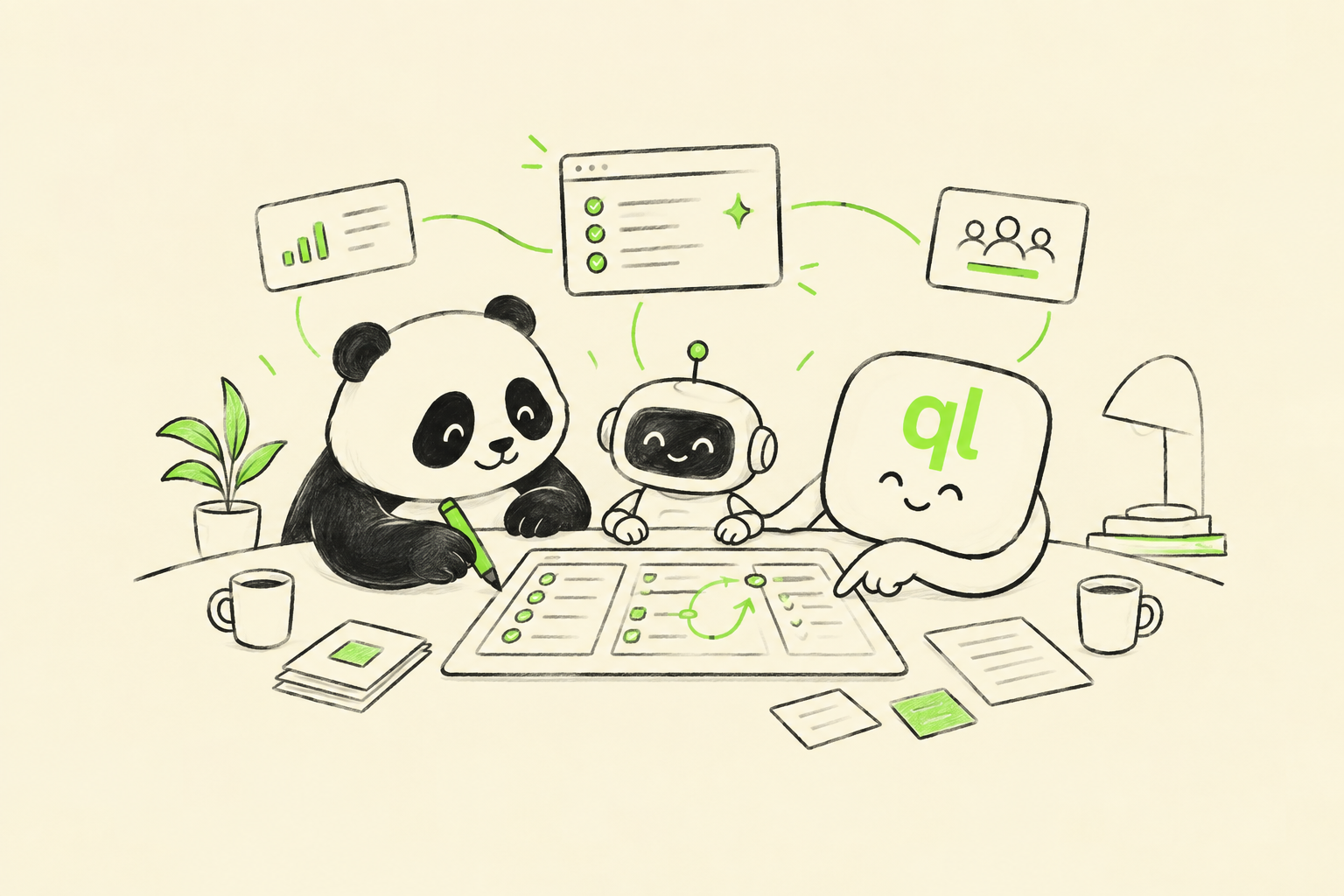
A multi-player AI bot is a bunch of AI agents AND a bunch of humans, all working together on the same job, in the same thread, sharing the same brain.
Think of an online game. Some players are people. Some are bots. Everyone's on the same map, chasing the same goal, and everyone can see what everyone else is doing. That's PromptQL's Bot. Minus the 12-year-old screaming into a headset.
…
Hold on. I can see it. Your head's spinning a little.
"Agents? What agents? I thought AI was just ChatGPT?"
Okay. Let me take a few steps back and start from the very beginning. Then we'll come back to PromptQL's Bot, and it'll click. Promise.
Step 1: The LLM (a.k.a. "the brain in a jar")
LLM stands for Large Language Model.
Imagine a student who has read every book, every website, every Reddit thread, and every terrible comment section on Earth. Then imagine that student became REALLY good at one party trick: guessing the next word.
That's it. That's the whole trick.
You type "Why is the sky…" and it goes "…blue?" You type "Write a poem about my cat" and it writes a poem about your cat that is, frankly, better than anything you'd write about your cat. Sorry.
Remember it like this:
LLM = the engine.
The engine is very impressive. It's also completely useless sitting in your driveway. You need a car around it. Which brings us to…
Step 2: ChatGPT, Claude, Grok (a.k.a. "the cars")
Here's the thing nobody tells you: ChatGPT is not an LLM. Neither is Claude. Neither is Grok.
They're cars built around the engine.
| The car (the app) | Who built it | The engine inside |
|---|---|---|
| ChatGPT | OpenAI | GPT models |
| Claude | Anthropic | Claude models |
| Grok | xAI | Grok models |
When you type a question, this happens:
You → ChatGPT (the app) → GPT model (the engine) → answer → you, slightly impressed, slightly nervous
The app adds the seats, the steering wheel, the cup holders: a chat window, memory of what you said two messages ago, web search, file reading, image making, a voice that sounds pleasantly human.
Engine vs. car. Say it with me. Great. Moving on.
Step 2.5: Context vs. Memory (a.k.a. "the desk vs. the filing cabinet")
Quick side note, because people mix these two up all the time, and it makes the AI look dumber than it is. It also happens to be the whole reason PromptQL's Bot exists, so pay attention. (Just for a minute. Then you can go back to scrolling.)
Context = what the AI knows RIGHT NOW.
You say: "I run Maarket.ai. It's a directory where founders find out what software teams are actually using." Then: "Give me 5 homepage headlines."
It uses the Maarket.ai thing to write the headlines. That's context.
Context = the papers sitting on the AI's desk. It can see them while it works.
Memory = what the AI keeps for LATER.
You say: "Remember that Maarket.ai is my startup." You disappear for a month. (Vacation? Backstreet Boys concert? Crying in a corner because you are turning 40? None of my business.) You come back: "Give me ideas for Maarket.ai."
It still knows. That's memory.
Memory = the filing cabinet. Closed now, opens later.
Now here's the catch. In ChatGPT, that filing cabinet is yours. Only yours. Your co-founder has her own cabinet. Your sales guy has his own cabinet. Every single person on your team is re-explaining what Maarket.ai is, to their own AI, in their own tab, every single day.
Remember that. It comes back later. (Foreshadowing! Like a real writer!)
Step 3: The AI Agent (a.k.a. "the brain finally gets hands")
So far the LLM only talks. Lovely talker. Doesn't lift a finger. Kind of like your one friend who "has ideas."
An AI Agent is an LLM that can actually DO stuff.
LLM = brain. AI Agent = brain + tools + instructions + the ability to take action.
The difference, live and in colour
You ask: "Find me 10 startups that should be listed on Maarket.ai but aren't yet."
A plain LLM goes: "Sure! Here are 10 startups!" and lists 10 companies it vaguely remembers from 2023. Three of them no longer exist. One is a bakery.
An AI Agent goes:
- Understands what you're actually after
- Searches the internet (the real one, today's one)
- Finds startups that fit
- Finds the founders
- Checks their websites
- Dumps everything into a spreadsheet
- Sends you the finished list while you were making tea
Same brain. But now it has a browser, a spreadsheet, and a to-do list. It can finish a job, not just describe one.
What's inside an agent?
| Part | What it does |
|---|---|
| LLM | Thinks, decides (the brain) |
| Memory | Remembers what matters (the cabinet, again) |
| Tools | Web search, email, databases, a browser, your calendar… |
| Instructions | The "here's your job" note taped to its forehead |
| Planning | Figures out what to do next, and next, and next |
Real example: Grok vs. Grok Bot
This is where Grok Bot comes in, and it's a great example.
- Grok = xAI's chat assistant. Talks.
- Grok Bot = an agent built on that same Grok engine. It has its own computer. It signs into your tools, uses them like you would, and — in their words — "never logs off."
Grok LLM = brain. Grok Bot = an AI employee built around that brain, with its own laptop, that doesn't take weekends.
Their tagline is "AI teammates that finish the work." That's exactly right. Grok Bot is an agent. You hand it a task, it goes and does the task. Beautiful.
Hold that thought too. We're about to compare it to PromptQL's Bot, and the difference is the whole point of this post.
Step 4: Multi-Agent Systems (a.k.a. "the group project, but nobody slacks off")
One agent is great. But some jobs are too big for one helper. So you use several agents, each with its own speciality, passing work down the line.
One agent: Human → Agent → Tools → Result
Multi-agent system: Human → Agent 1 → Agent 2 → Agent 3 → Result
It's a school group project — except every member actually shows up, nobody "forgot," and no one's mom emails the teacher.
Grok Bot does this too, by the way. You can run bots in one thread and they hand work to each other. Bots working with bots. Still an agent system. Just more of them.
Step 5: The Multi-Player AI Bot (a.k.a. PromptQL's Bot, a.k.a. the thing we started with)
Remember the online game from the top? Now it'll click.
Everything so far has been about AI working for you. You're the boss. The bot is the employee. You hand off, it hands back.
A multi-player AI bot is AI working with you. And with your co-founder. And your sales guy. And each other. All in the same thread, all looking at the same shared brain.
Multi-agent = bots working with bots. Multi-player = bots working with bots AND with humans. Together. In one place.
That's what PromptQL built. PromptQL's Bot is — in their own words — "a multiplayer AI agent. Think Claude or ChatGPT, but with shared threads and a shared brain."
Remember the filing cabinet?
(Told you it'd come back.)
In ChatGPT, everyone on your team has their own cabinet. With PromptQL's Bot, there's one cabinet for the whole team.
Someone at Maarket.ai tells the AI, once, "we count a product as 'listed' only when it has 3+ team recommendations." Done. Now everyone's AI knows that. Nobody re-explains it. PromptQL calls this "Teach it once. Everyone gets the skill."
Someone corrects the AI — "no, that number's wrong, we changed pricing in June." The correction sticks. For everyone. Forever. (Or until you change pricing again. Startups, man.)
What it looks like when it actually runs
Say the Maarket.ai team asks:
"Why did signups drop this month, and what should we do?"
Instead of one overworked agent doing everything (relatable), the work splits, and the humans stay in the room:
| Who | What they do |
|---|---|
| Research Agent | Digs up what competitors did this month |
| Data Agent | Pulls the signup numbers straight from the warehouse |
| GTM Agent | Checks the funnel: who landed on Maarket.ai, who actually signed up |
| Strategy Agent | Combines it all and proposes a plan |
| Founder (human) | Reads it, says "no, that assumption's wrong, the SEO drop was us, not them," and the whole team's AI learns it |
| Co-founder (human) | Jumps into the same thread, asks a follow-up, approves the plan |
The agents share context and hand work to each other. The humans jump in whenever judgment or approval is needed. And every time a human corrects something, it goes into the shared brain. PromptQL's Bot shows its sources and assumptions, so when it's wrong, you can see where it went wrong and fix it once.
The bots do the heavy lifting. The people make the calls that matter. Nobody gets replaced. Everybody gets faster.
So… Grok Bot vs. PromptQL's Bot?
Both are excellent. They're just playing different sports.
| Grok Bot | PromptQL's Bot | |
|---|---|---|
| The idea | AI teammates that finish the work | Multiplayer AI with shared context |
| Who's in the thread | You + your bots | Your whole team + everyone's bots |
| The brain | Each bot learns your workflows | One shared team brain everyone teaches |
| When a human corrects it | That bot learns | The whole team's AI learns |
| Best at | Handing off a task and walking away | Working through a problem together, with AI in the room |
| One-line version | "Go do this for me" | "Let's figure this out, all of us" |
Grok Bot mostly acts on your behalf. One boss, some very hardworking employees.
PromptQL's Bot's whole trick is the collaboration. Many humans, many agents, one shared brain, one goal.
If you're a solo founder who wants a tireless intern, Grok Bot is a fantastic pick. If you're a team tired of re-explaining your business to five different AI tabs, that's what PromptQL's Bot was built for.
The whole thing in one picture (screenshot this)
- LLM — the engine. Predicts words. e.g. GPT, Claude, Grok
- AI Agent — engine + instructions + tools + hands. Actually does things. e.g. Grok Bot
- Multi-Agent System — several specialist agents passing work to each other. e.g. several Grok Bots in a thread
- Multi-Player AI Bot — several agents + several HUMANS, one shared brain, one thread. e.g. PromptQL's Bot
Now go back to that Slack thread
Next time someone drops "multi-player AI bot" in the channel, don't nod with your whole neck.
Nod with your whole brain. Then ask, "Cool — is it AI working for us, or AI working with us?"
And if the answer is "with," go kick the tyres on PromptQL's Bot. We did. It's now listed on Maarket.ai, where you can see what teams are actually using it for — straight from the teams who use it.
(We brought snacks to that meeting too. Turns out it's a thing now.)
Frequently asked questions
What is a multi-player AI bot?
A multi-player AI bot is a group of AI agents and a group of humans working together on the same job, in the same thread, sharing the same brain — like an online game where some players are people and some are bots. PromptQL's Bot is a multi-player AI bot: agents and teammates share one thread and one shared team memory.
What is the difference between an AI agent and a multi-player AI bot?
An AI agent is an LLM with tools, instructions and the ability to take action — it works for you, like an employee you hand tasks to. A multi-player AI bot adds collaboration: several agents and several humans work together in one thread, with one shared brain that everyone teaches.
What is the difference between an LLM and ChatGPT?
An LLM (Large Language Model) is the engine — it predicts the next word. ChatGPT, Claude and Grok are cars built around that engine: apps that add the chat window, memory, web search and file reading around the raw model. ChatGPT is not an LLM; it is an app powered by OpenAI's GPT models.
What is the difference between context and memory in AI?
Context is what the AI knows right now — the papers on its desk while it works, like details you paste into the current chat. Memory is what the AI keeps for later — a filing cabinet it can reopen in future conversations. In most assistants that cabinet is private to you; in PromptQL's Bot it is shared by the whole team.
How is PromptQL's Bot different from Grok Bot?
Both are AI agents built on top of their own models, but they play different sports. Grok Bot is built to act on your behalf — one boss, several hardworking bots that finish tasks for you. PromptQL's Bot is built for collaboration — your whole team and everyone's bots share one thread and one shared brain, so a correction from any human teaches the whole team's AI.
Explore more product reviews on maarket.ai
Independent, hands-on reviews of the tools teams actually use.
Browse reviews