
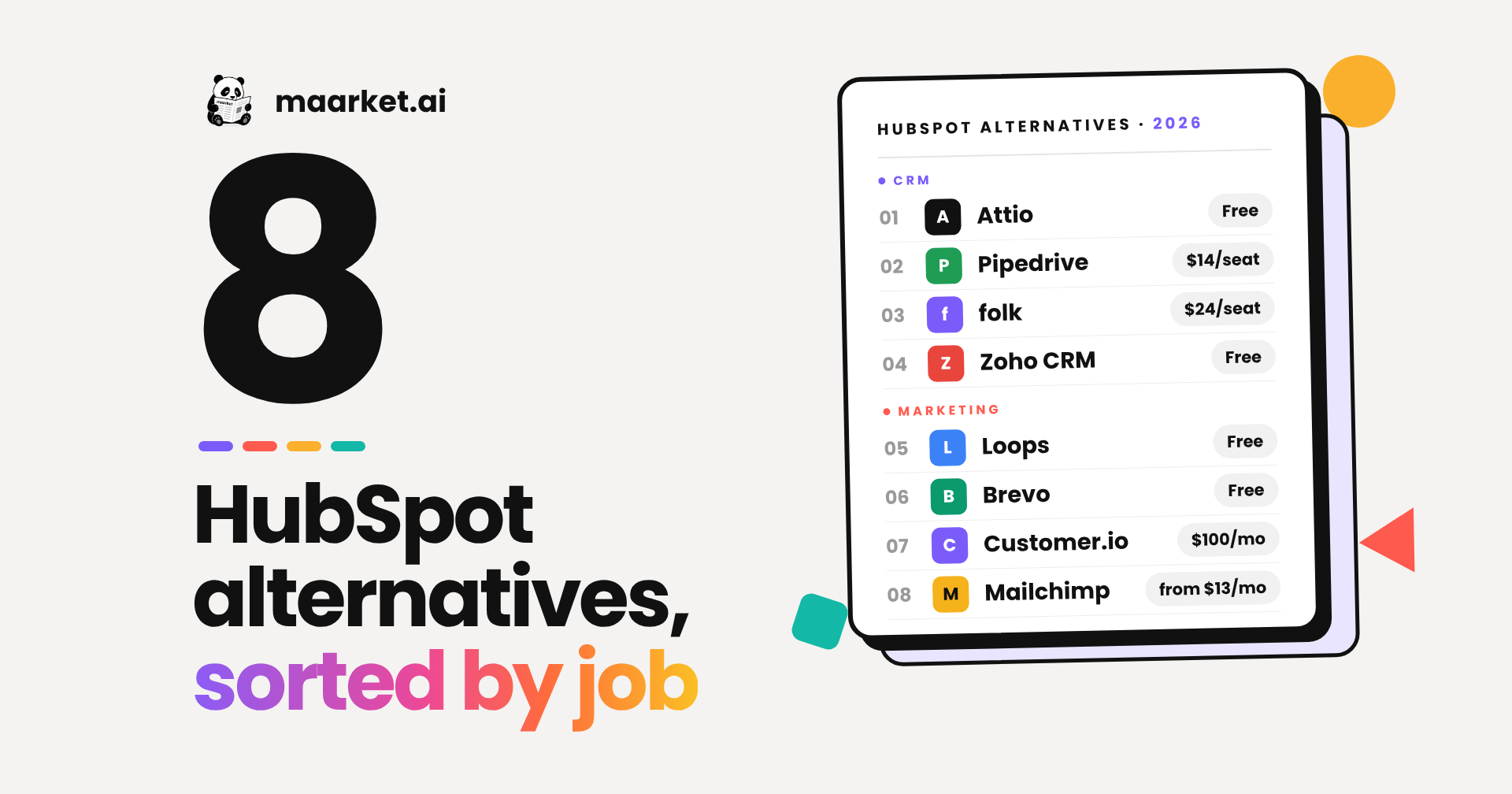
Last verified: November 24, 2026. Prices and plan limits were checked on each vendor's own pricing page on this date. Two exceptions are labeled in their entries: Zoho CRM's US prices (Zoho shows prices by region, so we confirmed the USD figures against August and September 2026 captures) and Mailchimp's price at 1,000 contacts (only shown in Mailchimp's calculator).
HubSpot is two products wearing one logo: a CRM and a marketing automation platform. Most startups that leave only need to replace one of them, so this list splits the eight best HubSpot alternatives into CRM replacements and marketing automation replacements, and prices each at the same benchmark: 1,000 contacts.
Compare every HubSpot alternative on Maarket →
Quick Answer
The best HubSpot alternatives for startups in 2026 depend on which half of HubSpot you're replacing. For the CRM: Attio (free for 3 users), Pipedrive ($14/seat/month, annual), folk ($24/seat/month, annual) and Zoho CRM (free for 3 users). For Marketing Hub: Loops (free up to 1,000 contacts), Brevo (free plan, 300 emails/day), Customer.io ($100/month) and Mailchimp (from $13/month). Four of the eight hold 1,000 contacts for $0, against $20/seat for HubSpot Starter and $890/month for Marketing Hub Professional.
HubSpot alternatives compared
Swipe sideways to see all columns →
# | Tool | Replaces | Starting price | Price at 1,000 contacts | Best for | Agent-ready (MCP) |
|---|---|---|---|---|---|---|
1 | Attio | CRM | Free (up to 3 users) | $0 | Data-heavy B2B and PLG startups | Yes, official MCP server on every plan |
2 | Pipedrive | CRM | $14/seat/mo (annual) | $14/seat (priced per seat, not per contact) | Sales-led teams with a defined pipeline | Yes, official MCP server on all plans |
3 | folk | CRM | $24/seat/mo (annual) | $24/seat (unlimited contacts) | Founder-led sales, investor and partner relationships | Yes, MCP included on all plans |
4 | Zoho CRM | CRM | Free (up to 3 users) | $0 | Budget teams that want a full CRM suite | Yes, official pre-built MCP servers |
5 | Loops | Marketing automation | Free (up to 1,000 subscribed contacts) | $0 | SaaS product and lifecycle email | Yes, official MCP server |
6 | Brevo | Marketing automation | Free (300 emails/day) | $0 on Free | Multichannel email and SMS on a budget | Yes, MCP listed from Starter |
7 | Customer.io | Marketing automation | $100/mo (Essentials) | $100/mo ($0 for year one via Startup Program) | Behavior-triggered messaging at scale | Yes, MCP server on all plans |
8 | Mailchimp | Marketing automation | Free (250 contacts); Essentials from $13/mo | Paid plan required; price shown only in Mailchimp's calculator | Newsletters and simple campaigns | Partial: official Claude connector, no MCP on pricing page |
ref | HubSpot | Both | Free (up to 2 users); Starter $20/seat/mo | $20/seat on Starter (1,000 marketing contacts included) | Teams that want one platform for everything | Yes, remote MCP server is GA |
"Price at 1,000 contacts" means the cheapest list-price plan that stores 1,000 contacts for one user, before tax, add-ons or limited-time discounts.
Why this list matters
Most "HubSpot competitors" roundups mix CRMs and email tools into one ranking, which is how you end up comparing Pipedrive against Mailchimp. This list separates the two jobs, prices every tool at the same 1,000-contact benchmark, and adds a column most roundups skip: whether the tool exposes an official MCP server your AI agents can use. Every price links to the vendor's own pricing page, and the two figures we couldn't read there are labeled rather than estimated.
HubSpot alternatives at a glance
| Stat | Value |
|---|---|
| Tools reviewed | 8 (4 CRM, 4 marketing automation), plus HubSpot as reference |
| $0 plan that holds 1,000 contacts | 4 (Attio, Zoho CRM, Loops, Brevo) |
| Any free plan | 5 (Attio, Zoho CRM, Loops, Brevo, Mailchimp) |
| Trial only, no free plan | 2 (Pipedrive, folk) |
| Official MCP server | 7 of 8 (Mailchimp offers an official Claude connector instead) |
| Startup discount programs | Attio, Customer.io (and HubSpot, on Professional and Enterprise) |
| Lowest paid entry | $9/mo (Brevo Starter) |
| Highest paid entry | $100/mo (Customer.io Essentials) |
The spread is wide because the pricing models differ. The CRMs charge per seat and mostly ignore contact count, while the email tools charge by contacts or send volume. That's why a five-person sales team and a solo founder with a 1,000-person waitlist should land on different tools.
What you lose leaving HubSpot
Leaving HubSpot is often the right call for a startup. It isn't free. Before you migrate, be honest about these five trade-offs.
- One database for marketing and sales. HubSpot ties a contact's first form fill to the deal that closes. Split your stack into a CRM plus an email tool and you rebuild that attribution with integrations, or you lose it.
- The marketing extras. Landing pages, forms, ads management, social scheduling and a CMS sit inside HubSpot. None of the four CRMs below replaces those, and the email tools cover only part of them.
- A real startup discount, if you need Pro. HubSpot for Startups offers eligible venture-backed startups up to 90% off year one, 50% off year two and 25% off year three. It applies to Professional and Enterprise products only; Starter is excluded.
- Agent access is close to a tie. HubSpot's remote MCP server is generally available to all accounts, with read and write access to CRM records. Seven of the eight alternatives here also ship an official MCP server; Mailchimp offers an official Claude connector instead.
- Migration time. Workflows, sequences, lead scoring and email history don't export cleanly. Budget for a rebuild, not a copy-paste.
What you gain: no required onboarding fee (HubSpot charges $3,000 on Marketing Hub Professional and $7,000 on Enterprise), no jump from $20/seat to $890/month when you need automation, and tools built for one job.
CRM replacements
1. Attio
What it is: Attio is an AI-native CRM that builds itself from your email and calendar and lets you model custom objects, so it bends to how a startup actually sells.
Pricing (attio.com/pricing): Free for up to 3 users and 50,000 records. Plus is $50/month billed monthly or $40/month billed annually (1 seat included; extra seats $44 or $35). Pro is $125 monthly or $100 annually. Venture-backed startups with up to 10 users can apply for 80% off annual Pro in year one and 30% off in year two, within 90 days of creating a workspace.
Standout: Every plan, including Free, includes Attio's MCP server, so Claude or ChatGPT can query and update your CRM. Agents, workflows and automatic enrichment are on the free plan.
Best for: B2B and product-led startups that want a flexible data model and AI agents from day one.
2. Pipedrive
What it is: Pipedrive is a pipeline-first sales CRM. Deals move through visual stages, and the product is built around what reps need to do next.
Pricing (pipedrive.com/en/pricing): Per seat, billed annually: Lite $14, Growth $39, Premium $59, Ultimate $79. There is no free plan; a 14-day free trial needs no credit card. Email campaigns are a separate Campaigns add-on on lower plans.
Standout: Pipedrive launched a native MCP server on June 30, 2026, available on all plans and maintained by Pipedrive, with OAuth and a full audit trail of AI actions.
Best for: Sales-led startups with a clear deal process and one or more reps who will live in the pipeline. Pipedrive on Maarket
3. folk
What it is: folk is a lightweight relationship CRM for founders, built for managing contacts across sales, fundraising, partnerships and hiring in one place.
Pricing (folk.app/pricing): Standard is $24 per user/month and Premium $48 per user/month, both on yearly billing (20% off). Enterprise starts at $80. Every plan starts with a 14-day free trial, no credit card. Contacts are unlimited on all plans.
Standout: MCP is included on every plan, letting AI tools search and update your folk workspace. Research, Follow-up and Recap assistants are included across plans too.
Best for: Founder-led sales and network-heavy work (investors, partners, candidates) where a full sales CRM is overkill.
4. Zoho CRM
What it is: Zoho CRM is a full-featured CRM from the Zoho suite, with workflow automation, Blueprint process rules and Zia AI on higher tiers.
Pricing (zoho.com/crm/zohocrm-pricing.html): Free for up to 3 users. Paid editions, per user per month on annual billing: Standard $14, Professional $23, Enterprise $40, Ultimate $52. Zoho shows prices by region, so these US list prices are confirmed against August and September 2026 captures; check the page with USD selected.
Standout: Zoho offers official pre-built MCP servers for Zoho CRM that work with Claude Desktop, Cursor, VS Code and other MCP clients.
Best for: Cost-conscious startups that want the deepest feature set per dollar and may later add Zoho's other apps.
Marketing automation replacements
5. Loops
What it is: Loops is an email platform for SaaS companies that handles marketing, product and transactional email from one tool.
Pricing (loops.so/pricing): Free up to 1,000 subscribed contacts, with 4,000 sends per rolling 30 days. Growth is $49/month with unlimited sends and no Loops branding. Unsubscribed contacts don't count toward pricing.
Standout: Loops runs an official remote MCP server, so AI tools like Claude and ChatGPT can manage contacts, events and transactional email.
Best for: Early SaaS teams that want onboarding, lifecycle and launch emails without a marketing ops hire.
6. Brevo
What it is: Brevo (formerly Sendinblue) is a multichannel marketing platform covering email, SMS and WhatsApp, with a built-in CRM.
Pricing (brevo.com/pricing): The Free plan stores up to 100,000 contacts and sends up to 300 emails per day, so a 1,000-contact list costs $0. Paid plans are priced by monthly email volume: Starter is $9/month and Standard $18/month at the entry 5,000-email tier, which stores up to 500 contacts. Larger lists move to higher tiers priced in Brevo's calculator. Professional starts at $499/month.
Standout: Brevo's pricing page lists "MCP for ChatGPT & Claude" from Starter, for managing campaigns and contacts from AI tools.
Best for: Small businesses that email a list occasionally and want SMS or WhatsApp in the same tool.
7. Customer.io
What it is: Customer.io is a behavioral messaging platform that sends email, push, SMS and in-app messages triggered by what users actually do in your product.
Pricing (customer.io/pricing): Essentials is $100/month billed monthly and includes 5,000 profiles and 1 million email sends per month. Premium starts at $1,000/month billed yearly. Its Startup Program offers a full year free to companies that have raised under $10M.
Standout: An MCP server is included on all three plans, and the event-driven model handles product-led lifecycle flows HubSpot Starter can't.
Best for: Product-led startups with event data and a growth or lifecycle owner.
8. Mailchimp
What it is: Mailchimp is Intuit's email marketing platform, known for templates, newsletters and simple automations.
Pricing (mailchimp.com/pricing/marketing): Free for up to 250 contacts and 500 sends per month, so a 1,000-contact list needs a paid plan. Essentials starts at $13/month and Standard at $20/month at the entry contact tier, and both rise with list size. Mailchimp shows the 1,000-contact price only in its pricing calculator, so check it there.
Standout: Intuit offers an official Mailchimp connector for Claude that plans and builds campaigns, plus a Transactional (Mandrill) MCP server. Mailchimp's pricing page doesn't list MCP.
Best for: Newsletters and straightforward campaigns where you don't need deep product-event automation. Mailchimp on Maarket
What types of HubSpot alternatives should you consider?
| Category | Representative entries |
|---|---|
| AI-native, flexible CRM | Attio |
| Pipeline-first sales CRM | Pipedrive |
| Relationship CRM for founders | folk |
| All-in-one CRM suite | Zoho CRM |
| SaaS lifecycle and transactional email | Loops |
| Multichannel email, SMS and WhatsApp | Brevo |
| Behavioral, event-triggered messaging | Customer.io |
| Newsletter and campaign email | Mailchimp |
Why price at 1,000 contacts matters
HubSpot's pricing changes shape as you grow, so the starting price tells you very little. Pricing every tool at 1,000 contacts, the point where many startups first outgrow a free plan, shows the real entry cost and exposes the per-seat versus per-contact difference early, before it compounds.
The trade-off is that any price snapshot ages. A static list is accurate the day it's verified and then drifts as vendors change tiers. Maarket ranks tools continuously instead, using ongoing signals such as reviews, "I use this" and recommendations from real teams, plus agent-readiness and MCP support, so the category rankings keep moving after this post is published.
Price shouldn't be the only filter. The cheapest tool at 1,000 contacts may be the most expensive at 25,000, and a free CRM that your reps won't use costs more than a paid one they will. Use the 1,000-contact price to shortlist, then decide on fit, migration effort and agent access.
How to choose a HubSpot alternative
- You only used HubSpot's CRM: pick from the CRM group. Attio for flexibility and agents, Pipedrive for a sales pipeline, folk for founder-led relationships, Zoho CRM for the most features per dollar.
- You only used HubSpot for email: pick from the marketing group. Loops for SaaS lifecycle email, Customer.io for event-driven messaging, Brevo for multichannel on a budget, Mailchimp for newsletters.
- You used both: pair one of each and connect them (native integration, Zapier or a CDP) so deal data and email engagement stay in sync. Typical pairs: Attio + Loops, Pipedrive + Brevo, Zoho CRM + Customer.io.
- You qualify for HubSpot for Startups and need Professional features: price HubSpot at the discount for years one to three, then at list price for year four, before deciding.
- Agents are part of your workflow: seven of the eight ship an official MCP server, and Mailchimp has an official Claude connector. Check which actions are read-only versus read-write before you give an agent access.
How we built this list
We started from the eight tools in Maarket's listings that founders most often compare with HubSpot, then verified each one on its own website: pricing page, free-plan limits and MCP or AI-connector documentation. HubSpot's prices come from its own pricing pages. Where a vendor page didn't show a number (Zoho CRM's US prices, Mailchimp's and Brevo's higher contact tiers), we say so instead of estimating. Prices are US list prices, before tax and limited-time promotions.
Last reviewed: November 24, 2026
Frequently asked questions
What is the best HubSpot alternative for a small business or startup?
It depends which half of HubSpot you use. For a CRM, Attio and Zoho CRM are free for up to 3 users, and Pipedrive starts at $14 per seat per month (annual). For email marketing, Loops is free up to 1,000 contacts and Brevo has a free plan with 300 emails per day. Most startups pair one CRM with one email tool.
What is cheaper than HubSpot?
At 1,000 contacts, Attio, Zoho CRM, Loops and Brevo all have a $0 plan that fits, and Pipedrive costs $14 per seat per month on annual billing. HubSpot Starter is $20 per seat per month at list price, and Marketing Hub Professional is $890 per month (or $800 on an annual commitment) plus a required $3,000 onboarding fee, as of November 2026.
Why is HubSpot so expensive for startups?
HubSpot charges on several axes at once: seats, marketing contacts and tiers. Starter is affordable, but automation and advanced reporting sit in Professional, which jumps to $800 to $890 per month plus a one-time $3,000 onboarding fee. Eligible venture-backed startups can get up to 90% off year one through HubSpot for Startups, on Professional and Enterprise only.
Is there a free alternative to HubSpot?
Yes. Attio's free plan covers 3 users and 50,000 records, Zoho CRM is free for 3 users, Loops is free up to 1,000 subscribed contacts, and Brevo's free plan sends up to 300 emails per day. HubSpot itself has a free plan for up to 2 users. Pipedrive, folk and Customer.io have no free plan, though Customer.io offers a free first year to startups that raised under $10M.
Pipedrive vs HubSpot: which is better for a startup?
Pipedrive is better for a sales-led startup that mainly needs a deal pipeline, at $14 to $79 per seat per month on annual billing, with an official MCP server on all plans. HubSpot is better if you need marketing, sales and service data in one platform, or if you qualify for the HubSpot for Startups discount on Professional.
Attio vs HubSpot: which CRM should a startup pick?
Attio suits startups that want a flexible, AI-native data model: its free plan covers 3 users and 50,000 records, and every plan includes its MCP server. HubSpot suits teams that want CRM, email, landing pages and service tools in one platform. If you only need the CRM, Attio is the leaner choice; if you need marketing in the same database, HubSpot is.
How hard is it to migrate off HubSpot?
Contacts, companies and deals move easily via CSV export or a vendor's importer. The hard part is everything built on top of them: workflows, sequences, lead scoring, forms and email engagement history usually have to be rebuilt by hand in the new tool. Map your active automations before you switch and migrate the ones you actually use.
Can I keep HubSpot's free CRM and use a different email tool?
Yes. HubSpot's free plan covers up to 2 users, and you can pair it with a dedicated email tool such as Loops, Brevo or Customer.io. Check that contacts and unsubscribes sync in both directions, natively or through Zapier or a CDP, so you never email someone who opted out.
Which half of HubSpot are you replacing?
Maarket ranks CRM and marketing tools continuously on real usage signals and agent-readiness, so you can see what teams like yours actually switched to.
Browse Sales & Lead Generation tools → · Browse Marketing & Growth tools → · See all HubSpot alternatives →