
Last verified: November 10, 2026. Pricing and data claims were checked against each vendor's own site on this date.
Most teams leave Apollo.io (the sales prospecting platform) for one of three reasons: bounce rates, price per seat, or patchy coverage outside the US. This list compares seven Apollo alternatives on the thing that decides all three: where each tool gets its emails, and what accuracy it claims for them. It's written for founders, SDR leads and RevOps folks choosing a prospecting stack.
Find Apollo alternatives on Maarket →
Quick Answer
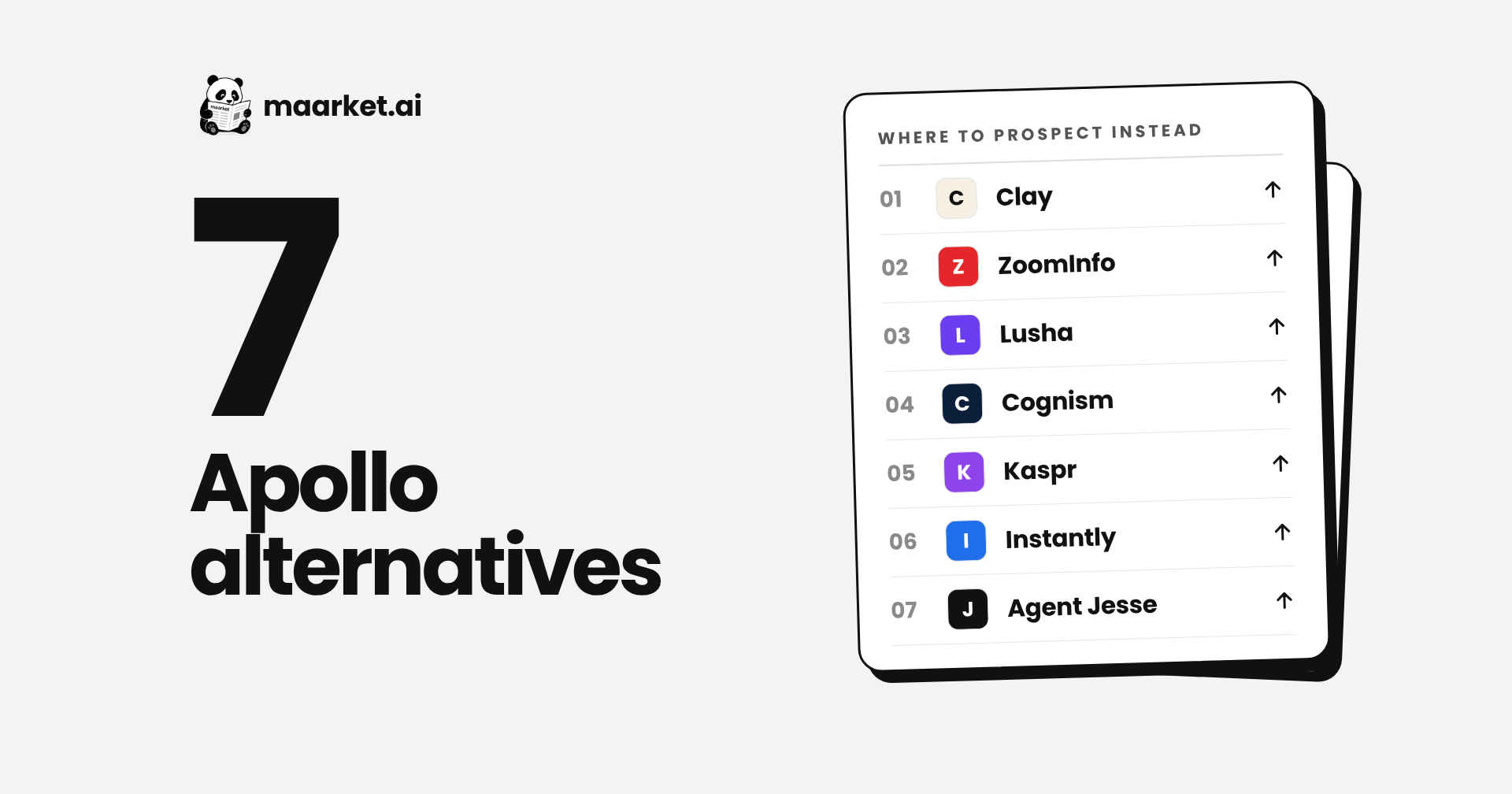
The best Apollo.io alternatives in 2026 are Lusha for verified emails with a published accuracy method, Cognism for European mobile numbers, ZoomInfo for enterprise coverage, Clay for multi-provider enrichment, Kaspr for a low-cost LinkedIn workflow, Instantly for cold email at volume, and Agent Jesse for done-for-you research. Pick by why you're leaving Apollo.
- Most transparent accuracy: Lusha (98% email accuracy, method published; free plan with 40 credits a month)
- European mobiles: Cognism (manually phone-verified Diamond Data)
- Enterprise coverage: ZoomInfo (500M+ contacts; up to 95% accuracy on first-party data)
- Multi-provider waterfalls: Clay (150+ data partners)
- Cheaper, EU-friendly: Kaspr (free plan; Starter €45/month billed annually)
- Cold email at volume: Instantly (Lead Finder credits from $9/month)
- Done for you: Agent Jesse, (one-time free credits, then $9/month)
Apollo alternatives compared
Swipe sideways to see all columns →
Tool | Starting price (Nov 2026) | Best for | Where emails come from | Published accuracy claim | Agent-ready score (Maarket check) | Maarket Karma Points |
|---|---|---|---|---|---|---|
Apollo (baseline) | Free; Basic $49/user/mo (annual) | All-in-one data plus sequencing | 2M+ contributor network, third-party providers, public web crawl | 98% email accuracy (seven-step verification) | 3/4 | 37 |
Clay | Free; Launch $185/mo($167/mo annual) | RevOps teams building waterfall enrichment | 150+ third-party data partners, chained in a waterfall | None of its own; depends on the providers you pick | 3/4 | 28 |
ZoomInfo | Free Lite plan (10 credits/mo); paid by quote | Enterprise teams needing breadth and intent | ML scanning of company sites, 300+ human researchers, contributor network, partners | Up to 95% on first-party data | 2/4 | Not listed yet |
Lusha | Free (40 credits/mo); Starter from $37.45/mo (annual) | Reps who want verified contacts with a published method | Opt-in community, licensed directories, public business info, pattern analysis | 98% email; 85% US / 86% global phone | 4/4 | Not listed yet |
Cognism | Custom annual quote (5 seats included) | Teams selling into Europe by phone | First-party sources, third-party providers, public sources, manual research | Phone-verified Diamond mobiles; no single email % published | 1/4 | Not listed yet |
Kaspr | Free; Starter €45/license/mo (annual) | Small EU teams prospecting from LinkedIn | Public sources, data partners; checks 120 sources at request time | No % published | 2/4 | Not listed yet |
Instantly | Lead Finder from $9/mo; Outreach from $47/mo | High-volume cold email | Own 450M+ database first, then 7 named waterfall partners | No % published; catch-all verification built in | 2/4 | Not listed yet |
Agent Jesse | Free (1,000 one-time credits); Pro $9/mo | Done-for-you account research from a sentence | Live web search on every query | Multi-step SMTP check; "95%+ deliverability" (vendor claim) | 3/4 | 63 |
Agent-ready score: Maarket's MCP check
Maarket ranks products partly on whether AI agents can use them, so we checked each tool against four criteria on November 10, 2026. Each one met earns a point.
Swipe sideways to see all columns →
Tool | Official MCP server | MCP on the free plan | Self-serve pricing published | Free plan to test | Score |
|---|---|---|---|---|---|
Apollo (baseline) | Yes | Not confirmed on Apollo's site | Yes | Yes | 3/4 |
Clay | Yes | No (paid plans) | Yes | Yes | 3/4 |
ZoomInfo | Yes (higher tiers) | No | No (quote) | Yes (Lite) | 2/4 |
Lusha | Yes | Yes | Yes | Yes | 4/4 |
Cognism | Yes (read-only) | No | No (quote) | No | 1/4 |
Kaspr | None found | No | Yes | Yes | 2/4 |
Instantly | Yes (hosted) | No (needs API key, Growth plan) | Yes | No (free trial only) | 2/4 |
Agent Jesse | Yes | No (Business plan) | Yes | Yes (one-time credits) | 3/4 |
Lusha is the only tool here that an AI agent can use on a free plan. Cognism scores lowest because there's no free plan and no published pricing, even though its MCP server works well for paying customers.
Why this list matters
Every Apollo alternatives post promises "better data." Few say where the data comes from, and that's the only thing that tells you whether an accuracy number applies to your list. The figures above don't measure the same thing: Apollo's 98% is email accuracy, ZoomInfo's 95% covers its first-party data, Cognism's verification applies to a phone-verified subset, and Lusha publishes its method with regional breakdowns. Each figure links to the vendor page it came from, and vendor claims are labelled as vendor claims.
For context, the baseline you're replacing: Apollo says its 240M+ contacts are built from a 2M+ contributor network, third-party providers and public web data, cross-checked against each other, with a seven-step email verification process behind its 98% claim. Paid plans run $49, $79 and $119 per user per month on annual billing, and the free plan includes 900 credits a year.
Tool-by-tool breakdown
1. Clay
What it is: Clay is a GTM data and workflow platform. It doesn't sell one database; it lets you chain providers so that if one misses an email, the next one tries.
Pricing: Free plan with 100 Data Credits and 500 Actions a month. Launch costs $185/month($167 billed annually) and Growth costs $495/month($446 annually). Enterprise is custom. Data Credits start at $0.05 each.
Standout: Data comes from Clay's marketplace of 150+ data partners. Since March 2026, Clay bills data (Data Credits) and platform work (Actions) separately, and says it cut marketplace data prices by 50 to 90%. Clay MCP runs inside Claude, ChatGPT and Codex on paid plans, so reps can trigger ops-built workflows from chat.
Best for: RevOps or GTM engineers who want to control which provider answers first. Accuracy is only as good as the waterfall you design, so it rewards teams with someone who owns data operations.
2. ZoomInfo
What it is: ZoomInfo is an enterprise GTM platform with one of the largest B2B databases: 500M+ contacts and 100M+ companies.
Pricing: ZoomInfo Lite is free forever with 10 credits a month and no card. Paid plans are custom-quoted on consumption credits and billed annually.
Standout: ZoomInfo describes a four-part data pipeline: automated ML scanning of 28 million site domains daily, third-party partners, a community of Lite users who share data back, and 300+ human researchers. It reports up to 95% accuracy on first-party data, plus 200M+ verified business emails. API and MCP access sit on its higher tiers.
Best for: Mid-market and enterprise teams who need breadth, intent data and org-level coverage, and who can live with a sales-led annual contract. On "Apollo vs ZoomInfo": ZoomInfo trades Apollo's published pricing for a bigger, researcher-backed dataset.
3. Lusha
What it is: Lusha is a B2B contact data platform with a Chrome extension, a workspace, an API and an MCP server, all drawing from one credit balance.
Pricing: Free plan with 40 credits a month, no card. Starter runs $49.90/month or about $37.45/month billed annually, with Pro and Premium above it and Scale on custom terms. An email reveal costs 1 credit and a phone costs 5; a lookup with no match costs nothing.
Standout: Lusha is the most open about method in this list. It states 98% email accuracy and 85% US / 86% global phone accuracy, broken down by region (North America 98%, EMEA 97%, APAC 96%, LATAM 95%). Data comes from four sources: an opt-in community that shares email headers and signatures, licensed partner directories, public business information and pattern analysis. Lusha says it doesn't scrape professional networks or social platforms. Its MCP works on every plan, including Free.
Best for: SMB and mid-market reps who want verified emails and direct dials without a contract, and buyers who care how an accuracy number was measured.
4. Cognism
What it is: Cognism is a sales intelligence platform built around compliant European data and phone-verified mobile numbers.
Pricing: Custom annual quote. Packages (Standard and Pro) include five seats. Cognism's own guides list Standard from $12,750/year and Pro from $17,000/year; confirm current figures with sales.
Standout: Cognism sources from first-party data, then fills gaps with third-party providers, public sources, manual research and partnerships. Its Diamond Data is the differentiator: mobile numbers manually verified by Cognism's research team and re-verified roughly every 18 months. It screens phone data against Do Not Call lists in 15 countries. Diamond verification covers a subset, not every contact; Cognism's help center says on-demand requests succeed for about 10 to 15% of UK contacts and 15 to 20% of US contacts. Its MCP connector is read-only and available on Standard and Pro.
Best for: Teams that cold call into the UK and EU and need GDPR-first data with DNC screening.
5. Kaspr
What it is: Kaspr is a Chrome extension and web app for pulling emails and phone numbers from LinkedIn profiles. It is part of Cognism and shares data with it.
Pricing: Free plan with 5 phone credits, 5 direct email credits and 10 export credits a month, plus unlimited B2B emails once you invite three colleagues. Starter is €45/license/month billed annually (€59 monthly) and Business is €79/license/month annually (€99 monthly). Prices show in local currency.
Standout: Kaspr builds its database from public sources (company websites, job postings, registries, social networks) and data partners, then checks a request against 120 sources in real time. We found no published accuracy percentage on its site. It says it aligns with GDPR and CCPA but doesn't scrub against DNC lists. No MCP server was listed on its site when we checked; API access is basic on Free and advanced on Business.
Best for: Small European teams and recruiters who prospect on LinkedIn and want something cheaper than Apollo for phone numbers.
6. Instantly
What it is: Instantly is a cold email platform with unlimited sending accounts and warmup, plus a built-in lead database called Lead Finder (formerly SuperSearch).
Pricing: Outreach plans start at $47/month (Growth). Lead Finder runs on a separate credit plan from $9/month for 150 credits, then $47/month for 1,500. There's no free plan, but Instantly offers a free trial with 100 credits. A verified email costs 1 credit when Instantly finds it and 2 when a partner does; misses cost nothing.
Standout: Lead Finder covers 450M+ contacts. It checks Instantly's own database first, then runs a waterfall through seven named partners: BetterContact, ContactOut, Findymail, IcyPeas, LeadMagic, Prospeo and Wiza. Catch-all verification runs automatically, and outside lists can be verified for 0.25 credits each. Instantly hosts an MCP server that exposes its full V2 API.
Best for: Agencies and outbound teams sending cold email at volume who want lead data and sending in one platform.
7. Agent Jesse
What it is: Agent Jesse, built by Floworks, is an AI prospecting agent. You describe your buyer and a buying event in one sentence; it searches the live web and returns matching companies and people, each with a dated rationale and named source. This is the "do it for me" path: it does the research and list-building, and you bring the sending tool.
Pricing: Free plan with 1,000 credits, given once, no card. Pro is $9/month (1,000 credits), Business $29/month (8,000 credits, plus API, MCP and n8n) and Max $100/month (30,000 credits). A search costs 10 credits, an email 5 and a phone 30. Annual billing saves 22%.
Standout: Unlike every other tool here, Agent Jesse doesn't query a stored database; it searches the live internet on each query, so results reflect what's published that day. Emails go through a multi-step SMTP check, and Agent Jesse claims 95%+ deliverability (vendor claim, no method published). It has no native CRM sync yet. If you want outreach handled too, Floworks sells a managed AI SDR from $498/month.
Best for: Founders and small teams whose problem is timing (who's buying now) rather than volume, and who'd rather describe a buyer than build a filter stack.
What types of Apollo alternatives should you consider?
| Category | Representative tools |
|---|---|
| Contact database with published accuracy | Lusha |
| Enterprise data and intent platform | ZoomInfo |
| Phone-verified, GDPR-first European data | Cognism |
| LinkedIn extension for low-cost lookups | Kaspr |
| Multi-provider waterfall enrichment | Clay |
| Cold email platform with built-in leads | Instantly |
| AI prospecting agent (live web search) | Agent Jesse |
How to choose an Apollo alternative
Start with why you're leaving:
- Bounce rates: pick a source with a published method (Lusha), a researcher-backed dataset (ZoomInfo), or a waterfall that only charges on verified hits (Clay, Instantly). Then verify again before you send.
- Price per seat: Lusha Starter and Agent Jesse start under $50 a month, and Kaspr Starter is €45 per license. Clay and Instantly price by plan and credits rather than per user seat, which helps once a team grows past two or three reps.
- European coverage: Cognism for verified mobiles and DNC screening; Kaspr if budget matters more than verification depth.
- You need sequencing too: Instantly replaces Apollo's sender; Clay can push to sequencers. The pure data tools (Lusha, Cognism, Kaspr, ZoomInfo Lite) need a separate sender.
- No time to build lists: Agent Jesse researches from a sentence.
- AI agents in your workflow: check the Agent-ready score above. Lusha is the only one whose MCP works on a free plan.
Then test before you commit. Run the same 200 to 300 real target contacts through your top two picks and count three things: fill rate (how often a field comes back), accuracy (how often it's right, measured by bounces and connects) and freshness (how many people have changed roles). Vendor accuracy numbers are a starting point; your own list is the test that counts.
How we built this list
We started from the seven tools buyers most often compare against Apollo.io and researched each from scratch on its own website: pricing pages, help centers, data and accuracy pages, and MCP documentation. Every price and accuracy figure links to the vendor page it came from. Where a live pricing page wouldn't load, we used the vendor's own help center or guides and noted it. We left out third-party bounce-rate tests published by competing vendors, because they don't state a method. The Agent-ready score is Maarket's own check against four fixed criteria.
Last reviewed: November 16, 2026
Frequently asked questions
What are the best Apollo.io competitors in 2026?
The main Apollo.io competitors are ZoomInfo (enterprise data and intent), Lusha (verified contacts with a published accuracy method), Cognism (European phone-verified mobiles), Kaspr (low-cost LinkedIn prospecting), Clay (multi-provider waterfall enrichment) and Instantly (cold email with a built-in lead database). Agent Jesse is an alternative approach that searches the live web instead of a stored database.
Does Apollo have a free plan?
Yes. Apollo's free plan costs $0 and includes 900 credits a year, with no credit card required. Paid plans start at $49 per user per month on annual billing (Basic), then $79 (Professional) and $119 (Organization, minimum three users).
Apollo vs ZoomInfo: which is better?
Apollo is better for small teams that want published pricing and built-in sequencing; paid plans start at $49 per user per month. ZoomInfo is better for larger teams that need a bigger dataset (500M+ contacts) built with 300+ human researchers, but paid plans are quote-based annual contracts. ZoomInfo Lite is free with 10 credits a month.
Apollo vs Clay: what's the difference?
Apollo is a database plus engagement suite: one dataset, sequences and a dialer. Clay is a workflow layer that pulls from 150+ data partners in a waterfall, so coverage depends on the providers you chain. Clay suits RevOps teams that build enrichment logic; Apollo suits reps who want one tool out of the box.
Apollo vs Lusha: which has better data?
Both claim 98% email accuracy. Lusha publishes the method behind its figure, adds phone accuracy (85% US, 86% global) and breaks email accuracy down by region. Apollo bundles data with sequencing and a dialer; Lusha is data-first and needs a separate sender. Lusha's free plan gives 40 credits a month; Apollo's gives 900 credits a year.
What's cheaper than Apollo?
Agent Jesse starts at $9 a month for the whole plan, and Lusha Starter costs about $37.45 per month billed annually, compared with Apollo Basic at $49 per user per month. Kaspr Starter is €45 per license per month billed annually. Lusha, Kaspr and Agent Jesse all have free plans, though Agent Jesse's 1,000 credits are given once, not monthly. Instantly's Lead Finder starts at $9 a month and offers a free trial rather than a free plan.
Which Apollo alternatives have an MCP server?
Clay, ZoomInfo, Lusha, Cognism, Instantly and Agent Jesse all offer an MCP server, so AI assistants like Claude and ChatGPT can query them directly. Lusha's MCP works on every plan, including Free. Clay, Agent Jesse and Instantly need a paid plan, ZoomInfo puts MCP on higher tiers, and Cognism's is read-only on Standard and Pro. We found no MCP server for Kaspr.
What's the best Apollo alternative for Europe and GDPR?
Cognism is the strongest Apollo alternative for Europe. It manually phone-verifies a subset of mobile numbers (Diamond Data) and screens phone data against Do Not Call lists in 15 countries. Kaspr, which is part of Cognism, is the cheaper option for small teams; it says it aligns with GDPR and CCPA but doesn't scrub DNC lists.
Which Apollo alternative has the most accurate email data?
No vendor's accuracy figure is independently audited, so compare methods, not just numbers. Lusha publishes 98% email accuracy with regional breakdowns and its method. ZoomInfo reports up to 95% on first-party data. Apollo itself claims 98%. Cognism focuses verification on mobile numbers. The reliable answer is to test 200 to 300 of your own contacts in each tool.
Looking for the right prospecting tool for your team?
Maarket ranks sales tools on ongoing signals from real users and counts MCP-native and agent-ready support in its scores, which is where the Agent-ready score above comes from. Browse the category, see what teams actually use, and compare before you sign.
Compare sales and CRM tools on Maarket →
Related: Best prospecting tools · Apollo alternatives on Maarket