

Customer support software used to be relatively straightforward. You had a help desk for tickets, a knowledge base for FAQs, live chat for conversations, automation for repetitive tasks, and analytics to measure how quickly your team responded. AI is changing that model. In 2026, the question is- “How much of the customer journey can this platform intelligently handle for me?”
Modern customer support platforms are moving from systems that help humans answer customers to systems that can understand customer intent, find information, recommend solutions, take actions, resolve issues, and know when a human needs to step in. That shift is already underway. Gartner reported in August 2026 that customer service leaders had increased spending on AI by 38%, while overall service and support budgets grew by only 2%. Gartner also identified generative-AI chatbots, voicebots and agentic AI platforms among the technologies expected to deliver the greatest future value.. This guide breaks down how AI is changing customer support software in 2026 and what buyers should look for before choosing a platform.
Quick Answer: How Is AI Changing Customer Support Software?
AI is changing customer support software by moving it from reactive ticket management toward proactive, automated and action-oriented customer service. The biggest changes primarily include: - AI agents resolving customer questions without human intervention - AI-powered ticket classification and routing - Automated responses based on company knowledge - Agent copilots that help human agents solve issues faster - Personalized customer responses - Voice AI for customer support calls - Predictive analytics for identifying customer problems - Multichannel AI support across chat, email, messaging and voice - Agentic AI capable of completing multi-step support workflows
Gartner found in 2026 that 58% of customers who use GenAI had used it to complete a task on their behalf, rising to 74% among B2B customers.
That means the next generation of customer support software needs to do more than generate a convincing answer. It needs to help customers get things done.
What Is AI Customer Support Software?

AI customer support software is customer service software that uses artificial intelligence to automate, assist, personalize or optimize interactions between businesses and their customers. Traditional customer support software primarily organizes customer interactions. AI-powered support software increasingly understands and acts on those interactions.
For example, a traditional help desk might receive: “I was charged twice for my subscription.”
The system could create a ticket and assign it to a billing agent.
An AI-powered system could potentially:
- Understand that the issue is a duplicate charge.
- Identify the customer's account.
- Check billing history.
- Verify whether the duplicate charge actually occurred.
- Explain the situation.
- Initiate an eligible refund.
- Update the ticket.
- Notify the customer.
- Escalate to a human if the situation falls outside its permissions.
That is a fundamentally different support workflow.
How Is AI Changing Customer Support?

Customer expectations have changed faster than many support teams can scale. Customers expect faster responses, 24/7 availability, personalized answers, self-service options, fewer touchpoints, consistent answers across channels and immediate resolution when possible. At the same time, businesses are under pressure to control support costs.
This creates a difficult equation:
More customers + more conversations + higher expectations ≠ proportionally more support staff.
Instead of simply adding more agents whenever ticket volume increases, businesses can automate repetitive interactions and give human agents better tools for the conversations that actually require human judgment. Gartner reported in 2026 that 91% of customer service and support leaders were under pressure from executives to implement AI. But there's an important caveat. AI isn't replacing the entire support team. The role of the human agent is changing. Let’s dive into greater detail-
1. AI Agents Are Replacing the Traditional Chatbots
One of the biggest changes in customer support software is the evolution from chatbots to AI agents. Traditional chatbots typically work through predefined flows:
Customer → chooses option → chooses another option → receives answer
They're useful for predictable questions but struggle when customers phrase things differently or when the conversation doesn't follow the expected path. However, AI agents can interpret natural language, retrieve information, reason about the customer's request and, increasingly, take actions through connected systems.
<For example: Customer: “Can you change my delivery address for the order I placed yesterday?”
A basic chatbot might provide a link to the order management page.
An AI agent could potentially:
- Identify the order
- Verify the customer
- Check whether the order can still be modified
- Update the address
- Confirm the change
Platforms are already moving in this direction. AI Customer Support is moving towards action-oriented experience.
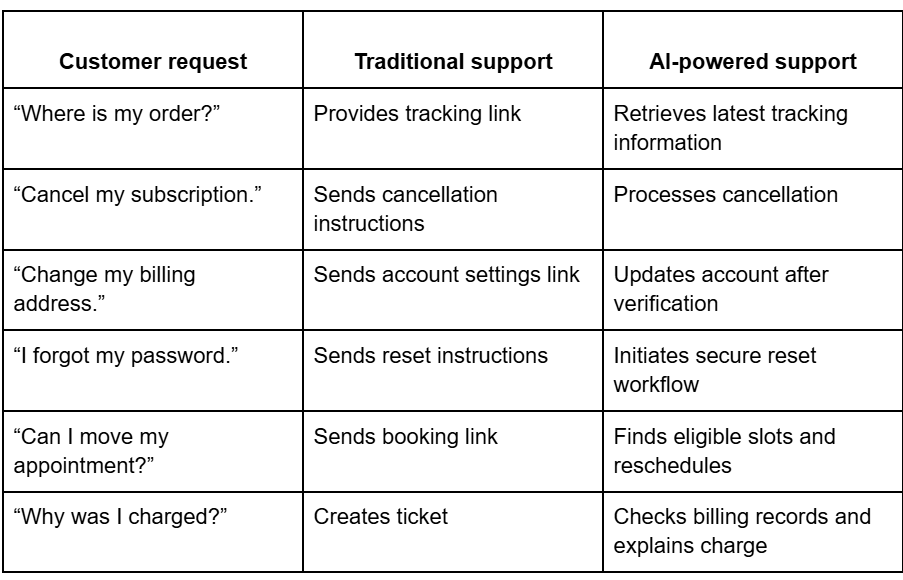
This is how things are changing and what buyers should be looking at. When comparing AI customer support software in 2026, evaluate actions per conversation, not just answers per conversation. A platform that can answer 10,000 FAQs isn't necessarily more valuable than one that can successfully complete 2,000 meaningful customer tasks.
2. AI Copilots Are Making Human Agents More Productive
AI isn't only changing customer-facing support. It's also changing the agent workspace. An AI copilot sits alongside a human support agent and helps them work faster. AI copilots work alongside support agents to make everyday tasks easier. They can summarize long conversations, understand customer issues, suggest replies, find relevant information, and recommend next steps. Instead of spending time reading through multiple tickets and notes, agents can quickly understand the problem and focus on solving it. Zendesk describes its agent copilot as a set of AI features that surfaces insights, recommends next steps and can execute agent-approved actions. This is particularly valuable for complicated support environments.
3. AI Is Changing Ticket Management
Ticketing remains important. But AI is making the ticketing layer much smarter. Traditional ticket management requires humans or rules to determine what the ticket is about, how urgent it is, who should handle it, what category it belongs to, whether it is a duplicate, what priority it should receive and so on. AI can increasingly automate these decisions. For example:
“The payment failed and I've already tried three cards. I need this fixed before my account gets suspended.”
AI could classify this as:
Category: Billing
Intent: Payment failure
Urgency: High
Customer sentiment: Frustrated
Suggested team: Billing support
Suggested action: Payment troubleshooting
This reduces manual triage and gets tickets to the right place faster.
AI Is Making Knowledge Bases More Useful
Knowledge bases have traditionally been difficult to maintain. Businesses might have hundreds or thousands of help articles, but customers still struggle to find the right answer. AI changes how customers interact with that information.
Instead of searching: “How to change subscription billing date?”
A customer can ask: “I need to move my billing date from the 15th to the 1st. Is that possible?”
AI can interpret the question and retrieve the relevant information. It can also summarize several knowledge-based articles into one response.
5. Voice AI Is Becoming Part of Customer Support Software
AI customer support is no longer limited to text. Voice AI is becoming increasingly important. This is particularly relevant for industries where phone support remains important including Healthcare, Financial services, Travel, Insurance, Home services, Hospitality, Retail and Logistics Gartner's August 2026 research identified GenAI voicebots alongside GenAI chatbots and agentic AI platforms as technologies expected to deliver substantial future value to customer service organizations.
6. AI Is Making Support More Personalized
Customers don't want generic answers. They want the company to understand: “Who am I, what have I done, and what am I trying to accomplish?”
AI makes it easier for support systems to use customer context. A support platform could potentially combine: - Customer profile - Previous conversations - Purchase history - Subscription - Product usage - Previous tickets - Account status - Customer segment
The AI can then tailor its response. For example:
“I can see you're currently on the Pro plan and your annual renewal is next month. The feature you're asking about is included in your current subscription.”
That's much more useful than:
*“Please check our pricing page.”
When comparing platforms, check which customer data the AI can actually use and what permissions and privacy controls govern that access.
7. Human Handoff Is Becoming a Critical AI Feature
Here's an important rule for buying AI customer support software:
The AI should know when it shouldn't be the one handling the conversation.
Customers don't want to get trapped in an endless AI loop.
In fact, Gartner found in 2026 that 87% of customers said companies using GenAI for customer service should provide access to a human agent.
Look for: - One-click human escalation - Automatic escalation based on intent - Sentiment-based escalation - VIP customer escalation - Confidence thresholds - Full conversation history - AI-generated summary for the human agent - Context passed to the agent - Ability to override AI decisions
The ideal experience is:
AI starts the conversation → AI resolves simple issues → human takes over when necessary → human receives the context.
Not:
Customer → bot → bot → bot → frustration → “Please email us."
8. AI Is Becoming Multichannel
Customers don't care which software your support team uses. They care about being able to contact you wherever they already are- email, chat, WhatsApp, SMS, social media, or phone. AI is making it possible to provide a more consistent support experience across all of them. For example, a customer might start a conversation on your website and continue it on WhatsApp or phone without having to explain the problem again. Intercom, for example, currently positions its support platform around channels including email, phone, SMS and WhatsApp alongside its AI agent and AI-powered workflows. The goal is no longer just supporting multiple channels, but making AI understand the customer and their history across every channel. Gartner has predicted that by 2029, agentic AI could autonomously resolve 80% of common customer service issues, with a corresponding reduction in operational costs. For buyers, this means the AI agent's ability to execute workflows may become more important than its ability to generate fluent text.
Top AI Customer Support Software to trend in 2026
Considering current momentum signals (funding, ARR growth, enterprise adoption) that make five names the most likely to still be trending. Have a look-
1. Sierra AI
The clearest momentum story in the category. Sierra crossed $100M in annual recurring revenue 21 months after launch and raised $950M at a $15B valuation in May 2026, and it's founded by former Salesforce co-CEO Bret Taylor, which has attracted significant attention from major consumer brands. This is currently the best-funded pure-play in the space — hard to bet against for 2026. In simple terms, Sierra is more than an AI chatbot. Its agents can connect to a company's CRM, order management system, knowledge base, and other business systems to solve customer problems end-to-end. For example, instead of a chatbot saying "You can return your order from your account," a Sierra agent could potentially look up the order, process the return, and confirm the next steps.
2. Decagon
The other half of what's being called the "arms race" in this category. According to Twig’s report, Decagon has raised $481 million in funding, reaching a $4.5 billion valuation, and Duolingo reports 80% deflection, Chime reports 70% resolution, with customer logos including Figma, Notion, Square, and Riot Games. Its differentiator lets CX teams write agent logic in plain English (Agent Operating Procedures) without touching code is exactly the kind of feature that tends to compound adoption. Decagon is primarily designed for large enterprises with high customer-support volumes. Its customer examples include Notion, Duolingo, Hertz, Chime, Oura, Rippling, Substack, Curology and ClassPass.
3. Intercom Fin
Already the incumbent-turned-AI-native example other lists point to. Intercom puts its Fin agent's autonomous resolution rate at 59% across email, chat, SMS, and social channels. Backed by Intercom's existing distribution, it's positioned to keep gaining share rather than needing to build a category from scratch. Intercom has built Fin directly into its customer service platform. The AI and human support teams share the same inbox, customer records, knowledge and workflows. One particularly notable current figure: Intercom says Fin averages a 76% resolution rate across 12,000+ customers.
4. Gorgias
Gorgias is a customer service and conversational AI platform built specifically for ecommerce brands. It combines a helpdesk, AI agents, customer data, automation, and ecommerce integrations in one platform. The clear vertical play- worth including specifically because "trending" often means dominating a niche, not going horizontal. Gorgias claims its AI Agent automates around 60% of repetitive storefront questions like shipping status and returns, making it the default answer for ecommerce brands specifically. Unlike general-purpose customer support software, Gorgias is particularly focused on Shopify and ecommerce businesses. Its native Shopify integration lets support teams see orders, customers, products, and other store data directly inside customer conversations.
5. Zendesk AI
The incumbent consolidation story. Zendesk's acquisition of Forethought signals the established players are buying their way into the agentic wave rather than getting disrupted by it- worth including because 2026 "trending" lists often skew toward whichever incumbent successfully absorbs the new capability, not just the newest startup. The biggest difference compared with Sierra and Decagon is that Zendesk already has a huge customer-service infrastructure underneath the AI. Think of it like:
Zendesk = Helpdesk + Ticketing + Knowledge Base + Automation + Analytics + AI Agents + AI Copilot
Have a Product to Share? Built a customer support or AI-powered software product? Submit your product to Maarket and get it in front of businesses looking for the right tools. → Submit your product
Conclusion
The best customer support software in 2026 won't necessarily be the platform with the most AI features. It will be the platform that creates the best balance between AI automation, human expertise, customer experience, integrations, reliability and cost. And as AI moves from answering questions to actually completing tasks, that distinction will become even more important. Looking for customer support software? Explore, compare and evaluate support tools on Maarket.ai to find the platform that fits your business, not just the one with the longest AI feature list.
Frequently Asked Questions
1. What is AI customer support software?
AI customer support software uses artificial intelligence to automate and improve customer service activities such as answering questions, resolving tickets, classifying requests, assisting agents, retrieving information and completing support workflows.
2. Is AI customer support worth it for small businesses?
It can be, particularly when a business receives a high volume of repetitive questions. Small businesses should prioritize affordable AI features such as self-service, AI-assisted replies, automated ticket routing and knowledge-base search rather than paying for complex enterprise AI capabilities they won't use.
3. What should I look for in AI customer service software?
Look for AI agents, knowledge retrieval, human escalation, agent copilots, automation, integrations, security controls, analytics, transparent AI pricing and the ability to take actions inside your existing business systems.
4. How do I compare AI customer support software before buying?
Start by identifying your most common support requests, then test shortlisted tools using the same real-world scenarios. Compare resolution quality, automation capabilities, integrations, human handoff, implementation effort, customer experience, and total cost not just the number of AI features.
5. What should I look for when choosing AI customer support software in 2026?
Look for AI resolution capabilities, integrations, workflow automation, human handoff, omnichannel support, knowledge management, analytics, security, and pricing. Most importantly, test how well the software handles your actual customer support workflows, not just its demo.